Let’s Check The Minutes

Meeting MinutesEveryone has pet peeves. We are no exception. One thing we have noticed in our work is that the quality of minutes taken – or not taken – at meetings make a big impact on an organization’s effectiveness.

Meetings are a valuable investment of time on the part of those who attend. We share perspectives, make decisions, and determine direction. Minutes are a way we can look back and recall what was discussed, decided, and the actions we agreed to take. When minutes are not accurate the result can confusion, misunderstandings, and a failure to meet important commitments.

We agree. There are many reasons why minutes may not be accurate. Here are a few:

  1. Minute taker was unable to track the conversation and record important points. He attempted to transcribe what was said instead of summarizing and recording major points.
  2. The meeting itself was not well organized or well facilitated.
  3. Agreements were not clearly stated so they could be recorded.
  4. The minutes were not completed and distributed in a timely fashion. By the time participants received the minutes they had forgotten what happened at the meeting and were left to “assume” the minutes are correct.
  5. There is no established format for minutes.

But, these can be overcome. Here are a few high-level suggestions for how to take good minutes:

  1. Record the names of all people participating. Indicate who is absent.
  2. Use the meeting’s agenda as a starting point. Record a summary of major discussion points for each item on the agenda.
  3. When you hear a decision being made re-state the decision to ensure you are recording it correctly.
  4. Record action items in a “next steps” section of the minutes. For example: Elizabeth to follow up with Mayor by Friday.

Creating and distributing accurate minutes in a timely fashion can increase the effectiveness of meetings. Here are a few “positive outcomes.”

  1. People get in the habit of making quantifiable agreements with due dates
  2. Prior decisions are easily referenced without having to revisit the whole discussion
  3. New group members understand prior actions and decisions

As always, you can be part of the solution. Here’s some suggestions for what to do if you are dealing with challenges in area of meeting minutes:

  1. When facilitating a meeting, or playing an important role, take your own notes.
  2. Cross reference these against the minutes to help ensure accuracy.
  3. Have a quick meeting after the meeting with the minute taker and the meeting’s leadership to ensure key points and agreements were recorded.
  4. Circulate a draft of minutes within 48 hours so corrections can be made before being officially sent to all participants.
  5. As a participant make sure you review the minutes prior to the next meeting so you can wisely vote to approve or modify.
  6. Make sure you know where the official minutes are kept. They should all be in one place that is easily accessible.

That’s it for now! Let us know how accurate and timely minutes help your organization.

Proposal Writing in the Age of Twitter

cheryl-clarkeWelcome guest blogger Cheryl Clarke. Here’s Cheryl’s words of wisdom on proposal writing in the age of twitter.

Twitter proposals.  That’s what I call those online grant application forms that ask a series of questions which applicants must answer within a specified word, or even character, count.  Can a nonprofit agency effectively tell its proposal story given such severe space restrictions?  It’s not easy, but it can be done. 

Online application forms require grantwriters to go on a verbal diet and write low-fat proposals rather than more caloric full-blown narratives.  For most of us, this means that online proposals are more challenging to draft.  Why?  Because we’ve got to make each word count.  We do not have the luxury of slowly building our case for support.  We’ve got to get straight to the point without taking a lot of descriptive detours.  Knowing what to include, as well as what to leave out, is essential.  What guides our decision-making?  Here are four “rules” I follow in preparing online applications.

• Focus on answering only the question that is being asked.  Unlike a tradition proposal narrative where the writer often has a little more flexibility in presenting the story’s sequence, the questions in an online application form dictate the narrative flow.  Writers must focus on the question at hand and should not digress into other topics as doing so will eat words and further limit the amount of available space. 

• Think of each answer as a mini story that must be complete in and of itself.  At minimum, each response requires a topic sentence that introduces the issue being discussed, a sentence or two that elaborates on the topic, and finally a concluding sentence that resolves the issue.  Naturally, if the application allows a greater word count, the mini story can be expanded.

• Don’t be afraid to use a descriptive word or phrase, just do so judiciously.  A well-chosen adjective or adverb adds color and often emotional depth to an answer.  Dispense with vague descriptive words such as “unique” and “innovative.”  Instead, show the reviewer what makes your agency’s work unique and how your agency’s service delivery is innovative.

• Write, review, edit, then edit again.  To ensure the required brevity of answers, first write a draft response to the question asked, then review and edit what’s been written, then edit again.  Be merciless with the editing pen and seek to eliminate all unnecessary words.

With a 400-word count for this article, this story’s end has been reached!

Learn more about Cheryl Clarke’s expertise, services, workshops and books!

Individual Donor Research – San Francisco Workshop

DERMajor Gifts on Limited Time: Using Research to Prioritize Prospects
Presented by Barbara Pierce
Friday, August 14, 2009, 12:00 to 1:30 p.m.
Development Executives Roundtable (DER)
Location: The Foundation Center, 312 Sutter Street, 2nd Floor, San Francisco
Co-sponsored by The Foundation Center

With so many responsibilities, how do you decide how to use your time most wisely? In this workshop, you’ll learn valuable tools to use in making time-efficient decisions about which prospects to focus on for the best results. We’ll discuss what prospect research can (and cannot) answer for you, where to start your search, tips on best research sites, an introduction to electronic wealth screening and finally, how to utilize the information you do find to cultivate and solicit potential donors.

About Barbara:
Since she was handed a list of 1,500 prospects at her first development job, Barbara has been an avid student of how to quickly identify the best prospects through research. Based in San Francisco, she is a development consultant with 15 years of experience in working with major gift prospects on gifts ranging from $10,000 to $1 million plus. She has worked with organizations including: California League of Conservation Voters, Planned Parenthood, Mills College, REDF (formerly The Roberts Enterprise Development Fund) and the George Lucas Educational Foundation. She can be reached at pierceconsulting2002@yahoo.com

Information/Registration:
Cost for Luncheon: DER members = $12, non-members = $20. Lunch is included in your fee. Because of DER’s special relationship with the Foundation Center, participants who wish to bring their own lunch can attend the meeting for no cost, but you still MUST register at the DER website. Please reserve by Wednesday, August 12 at www.dersf.org. Programs often sell out so don’t delay!

Boards and Fundraising: Common Complaints and Proposed Solutions

Is Your Board a Fundraising Board?

Is Your Board a Fundraising Board?

We hear a lot about boards and fundraising.  Below are comments and questions we hear from leadership and staff of organizations and from board members.  Do these sound familiar? Take a look.

Common staff comments and questions:

  1. How can we get our board more involved with fundraising?
  2. We give them a goal each year, but they never meet it.
  3. We can’t get 100% of our board to give.
  4. Our board is more interested in policy than in fundraising.
  5. Everyone agrees on our fundraising plan at the board meeting, but board members just don’t follow through.

Common board comments and questions:

  1. We are willing to get involved, but the goals are unreasonable.
  2. I didn’t join the board to raise money.
  3. They keep changing the fundraising goal – I need a strong and consistent case for support before I introduce my contacts to the institution.
  4. The CEO is unwilling to meet with prospective donors.
  5. I keep asking for training but I really haven’t gotten any yet.

It is always easier to point the finger at someone other than ourselves when we fall short of our goals. Here are some actions for staff and board members to take that can help increase collaboration in the area of fundraising. Circle each of the actions you are willing to take.

Staff Actions

  1. I am willing to meet individually with each board member to review our fundraising goals and objectives and to ask each board member how she or he would be willing to help us meet these goals.
  2. I am willing to let the board determine its fundraising goal.
  3. I am willing to secure ongoing fundraising training for the board that includes time for role playing, time for the board itself to agree upon a fundraising goal, and time for the development of strategies regarding how board members will achieve their agreed upon goal.
  4. I am willing to integrate quick and fun activities into all our board meetings that build the fundraising skills of the board.
  5. I am willing to work with the board president to learn how she would like to personally solicit each board member. I am willing to provide her with support, coaching, materials and training as needed so that she can take ownership of the board solicitation process and ensure 100% giving by all board members.
  6. I am willing to create a culture within our organization that is accountable, transparent and responsive to donor questions and requests.

Board Actions

  1. I am willing to make a gift to the institution that represents one of my largest annual philanthropic donations.
  2. I am willing to engage in fundraising as part of my responsibility as a board member even if feels uncomfortable to me.
  3. I am willing to invest the time it takes to become conversant in the mission, goals, programs and strategic plan of the organization I serve.
  4. I am willing to ask those I know whose values are in alignment with those of the institution I serve to make a gift to the institution or to a specific project.
  5. I am willing to ask questions of the organization’s leadership so that I can best respond to questions that other people may have about the organization. I am willing to ask the difficult questions that people talk about privately but won’t address publicly.
  6. I am willing to take the initiative to make sure that our board meetings always include active discussion and reporting by board members on the topic of fundraising and what we are doing to fulfill our agreed upon fundraising agreements.

It is always easier to point the finger at others. Our question is this – what are you willing to do?

Saad & Shaw provides organizations and institutions with creative and engaging board workshops. If you would like for us to work with you, please let us know. An easy first step is to work with How to Solicit a Gift: Turning Prospects into Donors. This book is written for fundraising volunteers. It walks the novice and the professional through the process of preparing to solicit, as well as guidelines for making the ask, and following up.

Are you a 50% Giver?

Hsieh Family Chooses to Give

Hsieh Family Chooses to Give

Bolder-Giving

“My wife and I decided to give away all our income above the U.S. median household income.” – Tom Hsieh

Do you know anyone who gives away 50% of their income? Believe it or not, people do. And they feel good. Read Tom Hsieh’s story.

Anne and Christopher Ellinger know 125 people who give away at least half of their income. They created Bolder Giving in Extraordinary Times to encourage bold giving.

“We live in a time of historic crisis and opportunity, when contributions of time and money could make a crucial difference.Yet most of us – even if well-off – give at a fraction of our capacity. Bolder Giving’s mission is to inspire us to give at our full potential by providing remarkable role models and practical support.”

Bolder Giving’s 50% Leagaue is one way they encourage more of us to give more.  You could be a millionaire and participate, or you have a much smaller income. The only requirement is that you have donated 50% or more of your income or business profits for at least three years, or 50% or more of net worth at some point in their lifetime, to causes that reflect your deepest values. (FYI, average U.S. giving is under 3% of income.)

“There’s nothing to counteract a feeling of scarcity like generosity.” – Anne Ellinger, founder Bolder Giving in Extraordinary Times

Read People who give half their money away in the SF Chronicle that inspired this blog

Passion, Creativity and Fundraising

Passionate Philanthropist

Vernon Foster: Passionate Philanthropist

When you work with a non-profit organization that is in line with your personal mission and values then everything is possible. Your creativity is sparked and you look to engage people with your non-profit and how you can advance its work.

Vernon Foster is an example of an individual who has combined his life passion with his philanthropy. A businessman who benefited from all that his father shared with him, Vernon has set out to offer to other young men what his father offered to him. After his father passed Vernon created the Charles P. Foster Foundation (CPFF) in his honor. The mission of the foundation is to assist African American youth, their parents and family members in leading meaningful, positive, successful lives and becoming productive citizens of society.  Vernon has worked to bring that mission to life by partnering with other people and organizations with a similar vision. He participates in collaboratives, has sought out national funding, and has begun piloting a model of what he would like to create – with others – to benefit young black men in the Bay Area.

For example, in 2001, Vernon donated 51 percent of the revenue from his company to CPFF for the purpose of providing jobs for graduates of the foundation’s Family Restoration Program and to help make the foundation financially self sufficient.

His most recent project is the publication of My Father Said: A Collection of Life Lessons. This book is another way that Vernon carries on his father’s legacy. It is designed for readers of all ages. Through the book Vernon brings to life his father’s message with stories from his childhood with his dad, photos and interviews with those who knew his dad. Throughout the book you will find life lessons from Charles Patrick Foster such as:

  • “Just because you go down the wrong road in life does not mean you can’t turn around.”
  • “If you speak the words, mean them, if not keep your mouth shut.
  • “Boy, here (in America) there is a recipe for everything to be successful. Your problem is you don’t want to follow the recipe.”

Vernon is offering his book as a gift to everyone who makes a gift the CPFF. You give to help advance the mission of the foundation, and the foundation gives you a gift to give to young people in your life. Visit the website at www.cpffoundation.org – give, get and give.

Ed McMahon and black history

Ed McMahon - co-host of the Lou Rawls Parade of Stars

Ed McMahon - co-host of the Lou Rawls Parade of Stars

This week America mourns the passing of Ed McMahon an entertainment giant, household name, and trusted American icon. He is remembered by the general public for his 30 years as Johnny Carson’s side-kick on The Tonight Show, his 12 years as the host of Star Search and his 16 years co-hosting TV’s Bloopers and Practical Jokes with Dick Clark.

He earned a place in American cultural history. And he earned a place in African American history.

As the creator and producer of the United Negro College Fund (UNCF) Lou Rawls Parade of Stars telethon I want to salute Ed McMahon for his work as the show’s co-host for over 17 years.

From the very beginning Ed lent his name, his prestige and his connections to the telethon. His role as co-host helped UNCF raise over $500 million and helped send thousands of young African Americans to college.

McMahon shared his celebrity, his reputation and his integrity with the telethon. His involvement helped to bring well established non-black entertainers onto the show giving it a “Good Housekeeping Seal of Approval.” His continuous role as co-host helped to extend the college fund into white homes who otherwise might have dismissed the telethon – and its important work of raising scholarship funds – as a “black thing.” Ed brought a diverse audience to the telethon. He gave the show credibility. He helped make the education of young black students an issue for all Americans to embrace.

When we wanted to engage a non-black entertainer Ed would make it happen. He would come into a room where we were meeting, pull out his little black book and personally call the entertainers we wanted on the show. He would ask and they would say yes.

You can’t buy what Ed McMahon gave. He was flexible and patient. He never asked for special treatment. He didn’t have an ego problem. He was a consummate professional. You could put a new script before him and he would read his lines as if he had been practicing for weeks.

He was so well liked by all. Of all the hundreds of stars who appeared on the show he was the easiest person to work with. He would spend enormous hours rehearsing. He never complained about all retakes and retaping. His famous line was “Point me where to go and I’ll do it.”

Ed McMahon is part of African American history!

Q&A – Private Public Partnership

Nicole Taylor, CEO - East Bay Community Foundation

Nicole Taylor, CEO - East Bay Community Foundation

One of the programs of the East Bay Community Foundation is it’s public/private partnership program. We thought you might want to know about this, so we asked questions on your behalf.

What is the Foundation’s public/private partnership program?
Based on the reality that neither government, business, the non-profit sector nor the philanthropic sector alone possesses the resources to resolve our most pressing challenges, our partnership program is dedicated to forming partnerships that pool resources from different sectors to develop solutions to specific problems.  Specifically, we look to partner with the private and public sectors. To make significant change, we need to go beyond the power of one.  We need the power of many.

Does this initiative provide funding for local non-profit?   
Funding for local non profits who focus on our two priority issues — advancing economic opportunities for adults and families in need and on ensuring very young children are successful in the education system — comes primarily from our grantmaking program rather than from our partnerships program.

What is an example of a public/private partnership that has exceeded the Foundation’s expectations?  
We are developing a program aimed at purchasing foreclosed homes in Richmond, rehabilitating them, and offering them to first-time home buyers who are low-to-moderate income families – thereby reducing neighborhood blight and creating financial assets for families.  If that program comes to fruition and if we are able to implement it at a significant level of scale, it will exceed our expectations.

How does this program impact communities of color in the East Bay?
The foundation is focusing on two issues – advancing economic opportunity for adults and families in need and ensuring very young children succeed in the education system so they will have economic opportunity when they become adults.  These issues  disproportionately affect communities of color. 

Because of that disproportionate impact, these two issues we focus on are directly aimed at communities of color in Alameda and Contra Costa counties.  The public and private partnerships program is currently working primarily on the issue of economic opportunities and development in communities with high need for job creation, job training, and asset-building strategies.  The communities we work in through these efforts are primarily communities of color.

Learn more by visiting the East Bay Community Foundation online at www.ebcf.org

Asking for money is just one step in the process

Fundraising Cycle - More Than Asking for Money

Fundraising Cycle - More Than Asking for Money

Now more than ever many organizations are looking closely at their fundraising programs. Leadership expects the fundraising department to do more, often with less.

Organizations and institutions are being challenged in new ways and development departments are facing new demands.

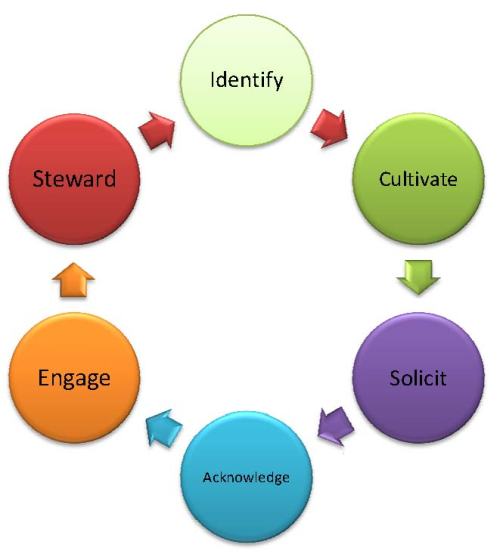
One of those demands is to move away from development to focus more exclusively on fundraising. Development is the long term process that includes fundraising. It also includes identification, cultivation, solicitation, acknowledgement, engagement and stewardship.

In these times you may feel the pressure to focus on bringing in the money and may be asked to ignore the larger part of the development cycle. But you may be cannibalizing your development and fundraising function in the process.

Identification is the process of identifying individuals with the interest and financial means to support your organization.

Cultivation is the process of getting to know your prospective donors and letting them get to know your institution.

Solicitation is when you ask for money. This is the one piece of the process that is sometimes mistakenly seen as the whole. But it is only one part. Solicitation can take place by mail, on the internet, in person, from the pulpit if your organization is a church, or at an event. You can ask an individual for a specific amount, provide a range of options, or simply let them determine what they can give. Solicitation also takes place when you submit a proposal to a foundation, corporation or funding agency.

Acknowledgement is when you thank and acknowledge donors for their gifts. This includes sending thank you letters and tax receipts, and including gift acknowledgements in your annual report or newsletter.

Engagement brings your donors closer into the life of your institution. Many donors can give more than money. They can give their time, provide technical expertise, help secure resources and services at reduced prices or advocate on your behalf.

Stewardship keeps you in relationship with your donors. You think about them at times other than when you are in need of money. You invite them to events, keep them updated on your organization’s programs, successes and challenges. 

As you can see, fundraising is just one part of development. Don’t try to save money by treating your donors as an ATM machine. Remember to focus on all the steps in the development process.

Learn more about fundraising

Copyright 2009 – Mel and Pearl Shaw

I’ll take a percentage

Fundraising ethics - something to consider

Imagine this. Your nonprofit organization is short on funds. A former co-worker tells you she knows someone looking to give $25,000 to an organization like yours. She says, “I’ll introduce you and facilitate the process if you give me 10 percent of whatever she gives you. You know, a finder’s fee.”

Or what about this. Your neighbor says your organization is a perfect fit for grants being made by the Obama administration. He says, “I’ll write the grant. If you get it, you pay me 10 percent. If you don’t get it, you don’t have to pay me.”

What do you do?

The above scenarios might seem ideal. You don’t have to do anything and your organization will financially benefit. You don’t have to hire staff, engage board members or spend a lot of your own time trying to secure a gift that may or may not come through. Do you say yes or do you try to reposition the offer?

As appealing as it may seem, both of the scenarios violate the Association of Fundraising Professionals Code of Ethical Principles. That’s right. Fundraising is a profession and fundraisers have a professional association that develops ethics and monitors adherence.

Ethical standard 24 from the association’s code of ethics states, “Members shall not pay finder’s fees, commissions or percentage compensation based on contributions and shall take care to discourage their organizations from making such payments.”

Here is the reasoning. Raising funds for a nonprofit is about obtaining the resources needed to advance the organization’s charitable or social mission. Importance is placed on retaining the trust of donors and ensuring that funds are used to fulfill the agreed upon social mission. Percentage-based compensation and finder’s fees can give rise to betrayal of philanthropic trust in an attempt to secure a larger gift and related fee.

Also, most people don’t give because of the skill and talent of your fundraiser. They give because they had a positive interaction with someone associated with your organization or because of a belief in your work. For the above scenarios, ask your coworker if she would volunteer to make the introduction because she believes in the value and impact of your organization. Ask your neighbor if he would write the proposal for a flat fee or hourly rate. Fundraising relies on volunteers and paid staff or contractors. It’s okay to pay fundraisers. Just don’t pay percentages.

Learn more about fundraising ethics at www.afpnet.org/ethics.