
Tag Archives: fundraising

How To Ask Your Donors For More Money

Soliciation Meeting - Fundraising, Donors Who Give

Soliciation Meeting - Fundraising, Donors Who Give

Are you willing to ask your donors for more money? What would it mean to your organization if you asked your current donors for a second gift? Do you think that because they have given once this year you shouldn’t ask them again?

If you are willing to ask your donors for more money, here are ten things to consider as you prepare to ask.

Ten Steps to Asking Your Donors For More Money:

  1. Share what your organization is doing now
  2. Share organization’s  recent (and current!) successes and how donor’s gift made a difference
  3. Share your vision and goals – what you are seeking to accomplish. Be concrete.
    “The current economy is impacting our students ability to stay in school. There are 32 seniors who will be unable to graduate this June because they have lost their jobs or their parents have lost their jobs. We are seeking to raise $232,000 to help ensure all our seniors graduate.”
  4. Communicate what it will take for your organization to deliver on its vision and goals. Let your donor know how much money you need to raise, how many volunteers you need, what type of technology you want to implement, what size building you want to rent or buy, what type of training your clients are seeking…
  5. ASK for opinions, questions and advice –
    “How do you think we should go about trying to accomplish this?” 
    “How should we proceed?”
    “You’ve been a volunteer for a long time, do you think this will work?” 
    “I know your graduating class tried something similar – what guidance would you offer us as we move forward?”
  6. LISTEN and affirm. If you ask someone for advice, questions or guidance, take it in. Do not argue or negate what the person says. You asked for his opinion, listen to it and respond in a positive manner.
    “Jack, I like that idea. I’ll share it with Monique and see if she can integrate that into our plan.”
  7. Share your plan for how you will raise the additional money you need.
    “Sonya, I am looking for 15 people to give $500 between now and June so we can meet the projected $7,500 shortfall in the after-school program.” PAUSE.
  8. ASK the person you are talking with if they are interested making this happen and who they think would want to join them.
    “Rev. Chang, would you be interested in supporting the new breast cancer survivor program at the hospital?” PAUSE. Are there people who you feel would want to join you?”
  9. ASK the person you are talking with if they would be willing to increase their giving.
    “Ramon, would you and your partner be willing to increase your pledge from $5,000 to $10,000?” PAUSE.

Note: we write PAUSE after so many of our suggested talking points  because we want to make sure you pause and let the other person share their thoughts. Giving the other person time to talk and LISTENING to what they have to say is vitally important to sustaining your relationship with your donors. And with your friends!

Word of Caution: Do not treat your donors as an ATM machine. Do not expect that because your organization has a financial need that your donors should AUTOMATICALLY fill that need.

– Mel and Pearl Shaw

Perspectives on philanthropy

Cedric Brown - Director, Mitchell Kapor Foundation

Cedric Brown - Director, Mitchell Kapor Foundation

Changes in the economy, the stock market and employment rates impact non-profit organizations and the foundations that provide funding to them. We posed a few questions to Cedric Brown, director of the Mitchell Kapor Foundation related to these changes.

1. How is the current economic climate impacting giving by Foundations?
The endowments and total assets of many foundations have “taken a hit,” a term I’ve heard repeatedly around the philanthropic community. This means that many foundations, like nonprofits, are re-examining and scaling back to most-essential programs and administration.
The recession has had a mixed effect on the grant monies that foundations are giving out – some funders are scaling back, while others see the need to make even more grants in order to help nonprofit organizations to sustain their work in these uncertain times.

2. What gets your attention in a positive way when you are reviewing proposals?
The best grant requests are concise, giving as much information as possible in as few words as possible. Additionally, I appreciate grant requests that outline the overlap between the grantseeker’s work and the funder’s priorities. I’m also intrigued by new ideas, in thoughtful expansion plans for effective work, and in collaborations between organizations.

3. What gets your attention in a negative way when you are reviewing proposals?
It’s vital to read the funder’s guidelines and follow the directions! I’ll admit that I initially scan grant requests to make sure that the work aligns with our funding priorities. If it’s off, I’ll know in a matter of seconds and will discard the grant request. I’m also biased against typos, poorly-written requests, and overly-written requests – that is, proposals stuffed with lingo and flowerly language.

4. What is the one piece of advice that you would offer to a non-profit that is considering applying for a grant?
I advise nonprofits to do three things before applying: 1) read the potential funder’s website to learn about their funding priorities and their application process; 2) call a program officer to briefly discuss whether or not your work is a good match for the foundation (and don’t try to make it fit if it isn’t); and 3) have someone else read and edit your written materials to make sure that it sounds coherent before submitting it to a funder.

5. What is an example of a project you funded that exceeded expectations?
We work with so many fantastic organizations that I’m hard-pressed to choose one. Overall I’ll say that my grantmaking has largely been an investment in dynamic and competent leadership combined with a solid work plan. So in this respect, nothing has surprised me.

I am pleased, though, that we were an early supporter of Van Jones’ work on green jobs (through Ella Baker Center and Green for All), which he’s taken from Oakland to the New York Times bestseller list to the White House!

 6. What would happen if an organization did not accomplish what it said it would do when applying for a grant? Does that automatically mean they could not get another grant? How is this handled?
While I believe in accountability, I also believe in being flexible and reasonable. Nonprofits (and foundations, too, for that matter) are subjected to changing information and conditions that can re-shape their ability to accomplish their original goals. I think adaptability is an important trait to possess, allowing community organizations to appropriately adjust their work and expectations. But it’s critical for nonprofits to talk with their funders about substantial changes, not to seek “permission” or to “spin” (which is very transparent and annoying), but to say “This is what we’ve encountered and this is our response. What advice do you have to give us?” This way the nonprofit can appropriately involve the funder in the re-strategizing.

In my experience, the majority of nonprofits accomplish much of what they set out to do. It may be a different product in the end, but most do good and worthy work. Of course, there are the occasional “wayward” organizations; I have no qualms about cutting them off and chalking it up to a lesson learned about what NOT to do.

7. Are there any other comments or information you would like to share with our readers?
Small, startup nonprofits are going to have a very difficult time securing support in this economy. There’s a feeling in the nonprofit and foundation sectors that too many nonprofits exist. My best advice is that if you’re thinking about starting a nonprofit, first make absolutely sure that nobody else is doing what you’re proposing to do. If there are similar programs, ask how you might work with them to help deepen or expand their reach, rather than starting a new effort altogether.

Learn more about the Mitchell Kapor Foundation at www.mkf.org.

Learn about grantwriting from a former program officer!

darlenehallTake advantage of this new NONPROFIT FUNDRAISING WORKSHOP SERIES. Here’s your chance to learn in a small group, interactive setting about what makes a proposal stand out. Learn how to frame your story, and how to get to know foundation staff given the cultural and power dynamics impacting relationship building. Learn from Learn from Darlene Hall a former program officer of color with 6 years experience in philanthropy at family and community foundation.
Community-based workshop locations in San Francisco and Oakland, California.

Workshop 1: Writing Your Best Proposal in April
April 2, 14, and 21 in San Francisco
April 15 and 23 in Oakland

Workshop 2: Building Relationships with Funders in May
May 7, 12, 19 in San Francisco
May 13 and 21 in Oakland
Costs:
• $40 for one workshop/$70 for both workshops
• Limited space! Sign up today!

Call Darlene A. Hall, Ph.D. at Intersections Conulsting for more information at 415.297.7265 or email her at
IntersectionsConsulting@gmail.com

Darlene brings 20 years experience in the nonprofit and philanthropic sectors that crosses several fields including mental health, teaching/training, youth development, social justice and social services, and sports/athletics.

How To Solicit a Gift

How To Solicit A Gift!Have you been asked to raise money for a non-profit, college, hospital or church? Are you willing but not sure how to proceed? Is it your job to prepare volunteers and staff to solicit gifts? If so, How to Solicit a Gift was written for you!

We wrote How to Solicit a Gift: Turning Prospects into Donors for two reasons. To help people learn how to ask others for a gift to an organization or institution they believe in. And to help the staff of non-profits, colleges, churches and hospitals understand how to best prepare volunteers to solicit gifts.

Fundraising is much more than simply asking people for money. 90% of fundraising is preparation. Only 10% is actual solicitation. Learn what it’s all about and how you can succeed.

Everything You Need to Know about Fundraising

fundraisingday2009Join us at Fundraising Day 2009 in San Francisco on Monday May 4th!
Fundraising Day 2009 is the West Coast’s premier full-day training conference designed for today’s development staff, executive directors, board members, volunteers, and consultants—from newcomer to seasoned pro. Fundraising Day 2009 offers ideas, tools and opportunities to refresh your skills and ignite your enthusiasm.

If you are charged with raising money for your organization this is the conference for you! Everything you need to know under one roof.  Meet your peers. Meet experts in the field. Learn best practices. Consider attending if you are a volunteer or a staff member. Get answers to your questions and find a way to help your organization.

Topics include: Raising Funds in Challenging Times, Annual Fund, Major Gifts and Campaigns, Donor Stewardship, Reality Grantmaking, Online Giving, Issue Caucuses, and much more! Scholarships are available if you need financial assistance! Continue reading

Fundraising People in the News – February 2009

February 2009 - Fundraising People in the News!

February 2009 - Fundraising People in the News!

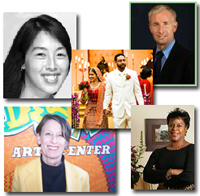
Join us in welcoming Priscilla Hung, Executive Director to her new position as the executive director of the Grassroots Institute for Fundraising Training, Elize Brown to the position of Administrative Director (Acting) Community Research Collaboration and HIPAA Privacy at Kaiser Permanente Department of Research, and Sean Sullivan to his new position as Development Director for Equality California. Congratulations to Renee Heider executive director of Destiny Arts Center for her selection as a LeaderSpring Leadership Institute Fellow and to Gurdeep Sihota on her marriage to Ahmad He’Bert.

$6.3 million raised for community college

lanecommunitycollegeFundraising by community colleges is increasing. Lane Community College just publicly launched its first capital campaign with an announcement of $6.3 million in gifts. Six donors joined together to launch the campaign with gifts ranging from $500,000 to $1,875,000. Learn more at The Register Guard.
Bay Area Blacks in Philanthropy Seminar

Bay Area Blacks in Philanthropy

Bay Area Blacks in Philanthropy

We will see you there!
Be there or be square!

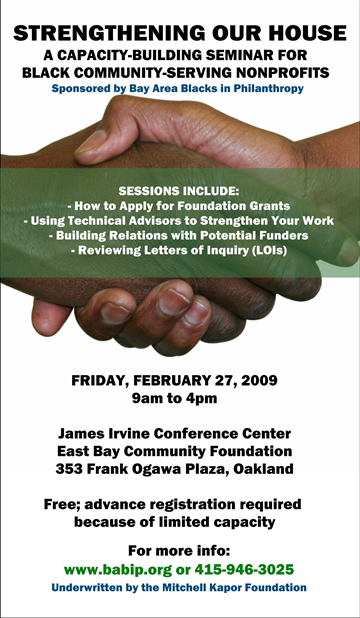
Sign up now for the Bay Area Blacks in Philanthropy seminar.

The focus is capacity building.

The seminar is free. Registration is required. More information at BABIP website or (415) 946-3025.

Increasing Diversity in Fundraising

Multicultural Alliance - Association of Fundraising Professionals, Golden Gate Chapter

Multicultural Alliance - Association of Fundraising Professionals, Golden Gate Chapter

Too many of us know there are too few trained and experienced fundraising professionals of color. We can bemoan the fact or learn from the model developed by the Multicultural Alliance (MCA) of the Association of Fundraising Professionals Golden Gate Chapter. Learn more by reading Mary Schmidt’s article about MCA.