

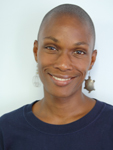
Cedric Brown - Director, Mitchell Kapor Foundation
Changes in the economy, the stock market and employment rates impact non-profit organizations and the foundations that provide funding to them. We posed a few questions to Cedric Brown, director of the Mitchell Kapor Foundation related to these changes.
1. How is the current economic climate impacting giving by Foundations?
The endowments and total assets of many foundations have “taken a hit,” a term I’ve heard repeatedly around the philanthropic community. This means that many foundations, like nonprofits, are re-examining and scaling back to most-essential programs and administration.
The recession has had a mixed effect on the grant monies that foundations are giving out – some funders are scaling back, while others see the need to make even more grants in order to help nonprofit organizations to sustain their work in these uncertain times.
2. What gets your attention in a positive way when you are reviewing proposals?
The best grant requests are concise, giving as much information as possible in as few words as possible. Additionally, I appreciate grant requests that outline the overlap between the grantseeker’s work and the funder’s priorities. I’m also intrigued by new ideas, in thoughtful expansion plans for effective work, and in collaborations between organizations.
3. What gets your attention in a negative way when you are reviewing proposals?
It’s vital to read the funder’s guidelines and follow the directions! I’ll admit that I initially scan grant requests to make sure that the work aligns with our funding priorities. If it’s off, I’ll know in a matter of seconds and will discard the grant request. I’m also biased against typos, poorly-written requests, and overly-written requests – that is, proposals stuffed with lingo and flowerly language.
4. What is the one piece of advice that you would offer to a non-profit that is considering applying for a grant?
I advise nonprofits to do three things before applying: 1) read the potential funder’s website to learn about their funding priorities and their application process; 2) call a program officer to briefly discuss whether or not your work is a good match for the foundation (and don’t try to make it fit if it isn’t); and 3) have someone else read and edit your written materials to make sure that it sounds coherent before submitting it to a funder.
5. What is an example of a project you funded that exceeded expectations?
We work with so many fantastic organizations that I’m hard-pressed to choose one. Overall I’ll say that my grantmaking has largely been an investment in dynamic and competent leadership combined with a solid work plan. So in this respect, nothing has surprised me.
I am pleased, though, that we were an early supporter of Van Jones’ work on green jobs (through Ella Baker Center and Green for All), which he’s taken from Oakland to the New York Times bestseller list to the White House!
6. What would happen if an organization did not accomplish what it said it would do when applying for a grant? Does that automatically mean they could not get another grant? How is this handled?
While I believe in accountability, I also believe in being flexible and reasonable. Nonprofits (and foundations, too, for that matter) are subjected to changing information and conditions that can re-shape their ability to accomplish their original goals. I think adaptability is an important trait to possess, allowing community organizations to appropriately adjust their work and expectations. But it’s critical for nonprofits to talk with their funders about substantial changes, not to seek “permission” or to “spin” (which is very transparent and annoying), but to say “This is what we’ve encountered and this is our response. What advice do you have to give us?” This way the nonprofit can appropriately involve the funder in the re-strategizing.
In my experience, the majority of nonprofits accomplish much of what they set out to do. It may be a different product in the end, but most do good and worthy work. Of course, there are the occasional “wayward” organizations; I have no qualms about cutting them off and chalking it up to a lesson learned about what NOT to do.
7. Are there any other comments or information you would like to share with our readers?
Small, startup nonprofits are going to have a very difficult time securing support in this economy. There’s a feeling in the nonprofit and foundation sectors that too many nonprofits exist. My best advice is that if you’re thinking about starting a nonprofit, first make absolutely sure that nobody else is doing what you’re proposing to do. If there are similar programs, ask how you might work with them to help deepen or expand their reach, rather than starting a new effort altogether.
Learn more about the Mitchell Kapor Foundation at www.mkf.org.
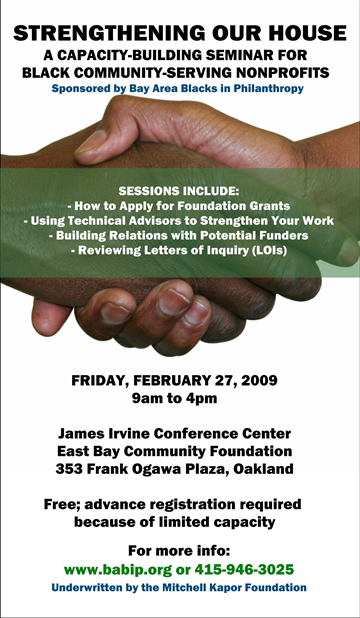
 Take advantage of this new NONPROFIT FUNDRAISING WORKSHOP SERIES. Here’s your chance to learn in a small group, interactive setting about what makes a proposal stand out. Learn how to frame your story, and how to get to know foundation staff given the cultural and power dynamics impacting relationship building. Learn from Learn from Darlene Hall a former program officer of color with 6 years experience in philanthropy at family and community foundation.


 FUNdraising Good Times