Faith in Action

If you are reading this after church, this blog is especially for you — because today’s issue is faith in action, the role of the church in the larger community. In years gone by the pastor’s preaching and personality, and the exuberance of the choir were enough to attract people to church and keep them coming back. Today things are a little different. The number of people filling church pews is smaller and so are funds collected in tithes and offerings. While there are many thoughts about why this is happening, there are also many people searching for a church home where their experience will extend beyond the building. They are seeking a church that is active in the community living out Christ’s message of love, compassion, forgiveness, healing, and social justice. They are seeking others like themselves who believe “as you do unto the least of my brothers, so you do unto me.”

Does your church offer members a meaningful way to live out their faith? Is yours a congregation that offers inspiring Sunday services as well as an opportunity to be of service throughout the week? Are young and talented people who want to make a difference attracted to your church? And if you are parishioner, are you satisfied with your church experience, or are you looking for a way to live out your faith?

In many churches it is the pastor who takes the lead in creating programs that meet community needs. Other times it starts with the church membership. If you are committed to your church home and seeking a greater sense of community involvement through your church, here are a few suggestions:

  1. Take initiative. You don’t have to wait for someone else to raise the issue of community involvement. Talk with your friends and family members about how your church can make a difference. Research community needs and existing programs. Canvass your membership about how they are willing to get involved. Bring your suggestions to your pastor and church leadership.
  1. Take advantage of existing programs. While your first thought may be to create a program within your own church, you may find that you can save a lot of time, energy and money by partnering with an existing secular program or a comparable program run by another church or by another faith community. For example, you can suggest that church members agree to serve as mentors for a local mentoring program instead of setting up your own mentoring program. If the church down the street has a meal program, suggest that your congregation support their work by volunteering and making a financial commitment. You don’t need to reinvent the wheel.
  1. Be consistent. Once you determine how you want to live out Christ’s message in your community, start small and stick with it. Don’t give up after the glow of something new begins to fade.

We have witnessed churches that are vibrant, growing, and attracting young families. They offer strong worship services as well as a way for members to make an impact in their community. We have witnessed church members who give of their limited time and money because they believe in the work of the church in their community. They believe their congregation can make a difference and they get involved.  If you are seeking more from your church experience you are not alone. Talk with others and take initiative to express your faith in action.

Would You Give Away 50 Percent?

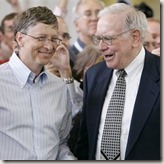
Bill Gates & Warren Buffett

By now you may have heard about The Giving Pledge. It is a movement started by Bill Gates and Warren Buffett to encourage other billionaires to pledge to give away at least 50% of their wealth. They want to encourage the richest people in the world to commit to charitable giving either while they are living or upon their passing. And they want each person or family who takes the pledge to make their pledge public and ask their peers to do the same. The goal: increased funding for philanthropy across the globe.

People taking the pledge are not asked to give to any specific charity or cause – they are simply asked to give. It is not a legally binding pledge but rather a morally binding one.

The idea grew out of a series of dinners hosted by Bill and Melinda Gates and Warren Buffet over the course of a year. Many of their peers have already made very substantial gifts and pledges. Now they are asked to publicly affiliate with others who are doing the same. The idea is for billionaires to inspire conversations with their peers about their giving, their intentions, and what they are learning through the process.

The impact will be felt for generations to come. When the Giving Pledge was announced earlier this month there were 40 billionaires who had signed on. These include 14 from California, 12 from New York, two from Texas and Georgia, one from Missouri and Michigan. Here are what a few have to say.

Michele Chan: Our passion, our mission is to transform health and health care, in America and beyond.

Tom Steyer and Kat Taylor: “We want to leave our kids a different kind of inheritance…we pledge the bulk of our assets to philanthropic activities carried out over the course of our lifetimes.”

Jim and Virginia Stowers: “More than 99% of our wealth will go to philanthropy during our lifetime or at death. We have already started our giving.”

Finally, here is what Vicki and Roger Sant have to say. “Our support of various not for profit organizations has given us enormous satisfaction particularly where we have been personally involved with the boards or committees of those institutions.”

We call special attention to their quote because it highlights the value people receive when they give their time and money. If you work or volunteer with an organization or institution do not be embarrassed to ask others to join you in giving their time, money and resources. Giving is an important part of life whether or not you are a billionaire. Think about this: you can make your own giving pledge. It doesn’t have to be 50% of anything. What it should be is a moral commitment you make to yourself. Do it. And ask others to join you. Together we are creating the world we want to live in.

To learn more about the Giving Pledge visit www.givingpledge.org.

Three Fundraising Workshops Not to Miss

Here are three upcoming workshops in the SF Bay Area that will help you raise money to better your community. Get out your pen and paper — or your iphone — and note the following dates so you can take advantage of these low-cost, high-quality learning and networking opportunities!

1. Apply now! If you need to know how to raise money from individuals for your non-profit then you need to sign up for the Fundraising Academy for Communities of Color. This seven month training program is focused on helping nonprofits based in communities of color in Alameda, Contra Costa and Solano Counties. The deadline to apply is Friday, August 20th.The Academy is offered by CompassPoint and the Grassroots Institute for Fundraising Training (GIFT) and begins in October.

 The Fundraising Academy helps nonprofits led by people of color that are primarily supported by foundation grants or government funds. Learn how to build a base of supporters from the communities you serve and advocate for. Learn how to shift your approach to fundraising, strengthen your skills, and increase your goals and results. Click here for more information or call (510) 452-4520 x301 and ask to talk with Manish. You can also visit www.grassrootsfundraising.org to find more great information to help grow your fundraising. Tell them Mel and Pearl sent you!

2. Craigslist Foundation Boot Camp. Saturday August 14, 2010 on the UC Berkeley Campus. This one-day boot camp is for people who are concerned about their communities and neighborhoods. The focus of Craigslist Foundation Boot Camp is simple: to connect, motivate and inspire greater community impact. This year’s boot camp has a new community-building focus that will bring together emerging and experienced leaders in the social and nonprofit sectors, aspiring and accomplished social entrepreneurs, professionals and decision makers from government, business and the community building sectors. If you want to learn from and network with people who want to enrich and empower their local communities and neighborhoods then this is the conference for you. To learn more visit www.craigslistfoundation.org or call (415) 278-0404. If you are a student or your organization has a budget of less than $500,000 the cost is just $99.

3. Fifth Annual Nonprofit Management Institute. October 5th – 6th on the Stanford University Campus. Hosted by the Stanford Social Innovation Review and the Association of Fundraising Professionals. This institute will help you figure out how to lead your organization during these challenging times of structural change. The recession has permanently changed the approaches organizations need to take to raise funds; nonprofits have to work with government in new ways; traditional governance models are shifting; and social media has turned communication upside down. This year’s institute will address these important strategic topics and emphasize the new leadership skills needed for managing and growing nonprofit organizations during times of dramatic change. Click here for more information visit or call 703-519-8494.

Don’t be left out! You need to know what it takes to stay afloat and grow. And as always, remember to have a FUNdraising Good Time!

Social Enterprise – Learn from an Expert!

There is currently a lot of buzz around social enterprise and earned revenue as ways for non-profit organizations to increase their financial resources. Some of these efforts are well-known, such as Good Will which generates 95 percent of its revenue from Good Will stores. Others are lesser known, such as SHOP, a social enterprise of A Miner Miracle in San Francisco, California.

SHOP is a clothing boutique that offers women and men designer fashions at greatly discounted prices. It opened its doors for business in 2003. The clothes are new, current, in season and sold at 50-80% below retail. The revenue from SHOP funds A Miner Miracle, a non-profit that provides professional clothing and image counseling to low-income to women and men seeking employment. Take a peek at their new video now showing on closed circuit television at select hotels in San Francisco. And take a look at how ABC TV covered SHOP in the evening news.

In order to learn more about what it has taken to grow this social enterprise we spoke with founder Kathy Miner.

Saad & Shaw – tell us a little about yourself, why you founded A Miner Miracle, and how SHOP came about?

Kathy Miner: I have a long history in the clothing industry, especially off-price, high-end clothing. Like many people, there came a point in my life where I wanted to combine my skills and passion with doing good. In 1995 I founded A Miner Miracle as a way of helping people who needed to dress for work for but didn’t have the clothes or money to do so. Things went well, and in 2001 I was recognized by Oprah Winfrey’s Angel Network. Then came the 2002 recession and I had to seek out new funding sources. I couldn’t continue to rely on foundation grants. I started hosting special shopping events – these were clothing sales where people could buy beautiful clothes at drastically reduced prices. All the money went to A Miner Miracle. With my background in clothing I went on a buying trip to Los Angeles and found designer label clothing and some financial donations.  I hosted four special clothing events before I finally decided to open a permanent store. I was lucky enough to be given a great location as a donation. That meant I didn’t have to pay rent. I tried many different concepts over a four year period before things really started to click.

In my fourth year I realized that I was going to have to go to New York to buy high end quality clothing and brand names. With this change SHOP became a fundraising vehicle for our agency and our target customer became anyone who likes a discount of 50-80% below retail for brands such as Ann Taylor, Calvin Klein, Michael Kors.

Saad & Shaw: A few questions about details. Is SHOP a part of A Miner Miracle or is it a separate 501c3 or is it a privately held business? And how does SHOP operate? What percentage of A Miner Miracle’s budget comes from SHOP revenue?

Kathy Miner: The name is “A Miner Miracle SHOP where giving is always fashionable.” We operate under one 501(C)3. SHOP operates like any retail store. I have a full staff who are hired with retail clothing experience. I also have an intern retail program to assist with some of the needs of processing and tagging the clothes. We train our interns in all areas of retail where we need help. At this point in time about 80% of the budget is supported by SHOP. Our goal is to have almost all the budget come from our store(s). In times like this, it has allowed us to continue serving over 600, men, women, young adults a year including those who have “aged out” of foster care and veterans who are homeless.

Saad & Shaw: What have been some of your biggest challenges and how have you overcome these?

Kathy Miner: The biggest challenge has been funding for SHOP. We started very slow with clothing events and then built up. We were only open three days a week in the beginning and built up to six days. That took four years and it was not easy by any means. Having a social enterprise support our agency means that really I am running two businesses at the same time. In our case it also meant doing it all with one small staff at the beginning. We have a line of credit and I also invested in the business. I don’t recommend doing that, but desperate times call for desperate measures.

Saad & Shaw: What role does in-kind services and donated merchandize play in SHOP’s success?

Kathy Miner: I have one great label donating all their samples to us. However, the shipping from NY costs over $50,000 alone. I have made relationships with many of the big brand names and they sell to SHOP at really good prices. Remember I sell everything at 50-80% below retail so I have to keep my buying price very low to make a profit. Having donated products is always preferable but for my concept not something that I could depend on. You have no choice when you get donations and many times it is hundreds of the same garment in one color. If you want a high quality store you have to choose – and often times buy – high quality merchandise.

Saad & Shaw: It seems as though you depend upon a great number of people to provide SHOP with in-kind goods and services or greatly reduced prices. How do you keep these businesses and individuals engaged with SHOP?

Kathy Miner: I keep as many people as I can engaged in our non-profit and the success of the business. I have a fashion advisory board, a business sponsor partnership, and I make sure that everyone gets recognition for helping us. It has been harder in this economy because the clothing business has been hit so hard it and many vendors have closed. I send photos, news pieces, and videos to keep them connected. I make sure I visit when I am back east and take San Francisco chocolates, sour dough bread and California wines. I let them know how much I appreciate all they do for us and make my success their success. People want to give. I do not ask anyone to donate except once a year for our big SHOP for Charity event. This means they don’t hide when I call or come to town. It is a win-win situation for all of us.

Saad & Shaw: What guidance would you offer to other organizations who would like to build a social enterprise to support their organization or institution?

Kathy Miner: Do something you know very well and love. If you can find something that ties into your service that is good. Don’t train on the job. Pick a service or product that is needed to a large population. Have a good board and do your due diligence and market research before starting anything.  Get as much donated as possible but consider your social enterprise a business and not a non-profit. Social enterprise is not necessarily the answer to your money problems and could in fact take more resources than you receive. Go slow, test every idea first.

Visit SHOP (and purchase wonderful clothes at a great price and help change the lives of others!)

A Miner Miracle SHOP
441 Sutter St (between Powell and Stockton)
San Francisco, CA 94108
(415) 398-2155

A Miner Miracle/ SHOP

 Be sure to tell them Mel and Pearl sent you! And as always, remember to have a FUNdraising Good Time!

Celebrate a New National Park

Sometimes a dream appears so big you wonder if it can come true. Here is our position: Believe that you can, and then bring together people who share your vision and are willing to contribute their talents, connections, time and money to make it happen. That’s how we got our newest national park and a tribute to Black history.

About five years ago we were asked to help create awareness and support for the idea of making Port Chicago – the Concord, CA area site where the largest U.S. home front disaster during World War II took place – a part of the national park system.

Our founder, Mel Shaw, had just brought together a group of local African American leaders and influencers to encourage Black families to visit Yosemite National Park — so we were the right people to ask. But would others come out to support Port Chicago as well? The only way to find out was to ask.

When we asked – and invited – people came out. They wanted to learn more about the explosion at Port Chicago and the young Black men who made history by standing up to the military, risking court martial, and who in the process helped integrate the armed forces.

The Port Chicago explosion at the naval magazine killed 320 men, 202 of whom were African-American. The explosion, work stoppage, and subsequent mutiny trial provide insights into the injustice of racial discrimination, the African-American experience in the U.S. military, and home front life during the Second World War. These events ultimately led to the desegregation of the armed services in the United States.

The people who came out that day five years ago launched the Friends of Port Chicago National Memorial a 501 c3 led by Rev. Diana McDaniel, a Unity minister from San Leandro. Fast forward to Fall 2009 and with the help of many friends, including Congressman George Miller (D-CA), our first African American president signed legislation that made Port Chicago a national park.

The legislation, signed as part of the FY2010 Defense Authorization Act elevates Port Chicago from an affiliated park site to a full unit of the National Park System. This allows the Park Service to create a national park visitor center and receive increased funding to hire park rangers to share the site’s story with the public.

This past Saturday the 66th commemoration of the explosion and dedication of our new national park was celebrated. Take a look at the event. For more information see www.nps.gov/poch. And as always, continue to have a FUNdraising Good Time!

Keeping the Community in Community Foundations

Community foundations play a major role in communities across the country. They are a vehicle for organized giving that primarily benefits a specific geographic area. They bring together individual donors, local businesses, families, and others to pool their resources and make grants.

Here is how the Austin Community Foundation defines what a community foundation is: A community foundation is a philanthropic vehicle that combines the charitable gifts of many to provide leadership and financial leverage in addressing the current and future needs of the community through various grant making activities designed to improve the lives of the citizens of that community.

And here is what the Community Foundation of Greater Memphis is doing to encourage local residents to give to the foundation, and to have a say in how those funds are granted out to local organizations. They call their campaign GiVE 365. The campaign was launched with the belief that everyone can be a philanthropist. They especially want to engage people in their 20’s, 30’s and 40’s though anyone can participate. Annual membership is $365, or a dollar a day.

GiVE 365 helps participants to change how they know themselves. When you join GIVE 365 the definition of philanthropist changes. A philanthropist is not someone else. A philanthropist is you and me. Making a commitment to GiVE 365 puts everyday people in the driver’s seat. As long as you can give $365 a year you are in the mix. And it is a mix.

Being a member of GiVE 365 means you give and you grant. You – and the other members of GiVE 365 – get to work together to determine how the funds given should be granted. Now that is an unusual experience for many of us. Usually we – and our organizations – are on the soliciting-side of philanthropy, not the decision-making side. Participating in a donor circle such as GIVE 365 changes the dynamic so that you become a decision-maker.

This is a new program at the Community Foundation of Greater Memphis and those who participate will help shape the program. To kick it off the foundation matched the first $20,000. We talked with Bob Fockler, the president of the foundation and he said “We are really excited about the prospects for GiVE 365. Memphis has been shown to be a city full of very generous people, yet we are far from a wealthy city. GiVE 365 provides an opportunity for people from virtually all economic backgrounds to have an active part in helping to transform this city. After all, most great things come about as a result of the collective actions of a great many people.”

If you are interested in starting such a program in your community, call your community foundation, ask to speak to a program officer, and tell them you read about what the Community Foundation of Greater Memphis is up to. Be sure to say you want to help make it happen. GIVE 365. It’s worth it!

Community College Trends, Part Two

Last week Robert “Bobby” McDonald, a member of the California Community Colleges Board of Governors, talked with us about community college trends. This week he discusses the importance of fundraising by community colleges.

Saad & Shaw – Why do community colleges need to engage in fundraising?

McDonald –In 2008, California’s Community Colleges made history, when they received the largest gift to community colleges. The Bernard Osher Foundation made a commitment of $50 million to the California Community Colleges, which created a new trend in community college philanthropy, helping raise awareness of the need to increase scholarship support to California’s community college students. With an additional $50 million funds, raised by our community colleges and the scholarship endowment, the total could reach $100 million.

The goal of the California Community Colleges Scholarship Endowment is to support student success and opportunity by creating a permanent fund for scholarships, offering long-term relief to the rising costs that keep many students from completing their education.  Our communities need to actively support the fundraising goals of the community colleges in their area to help support a winning opportunity that has a clear total impact on our future.

Saad & Shaw – What are the challenges that impact district chancellors and college presidents as they begin the work of fundraising?

McDonald – Before our financial crisis, there wasn’t a strong emphasis to fundraise. Now there is a need to find good development/foundation consultants, community organizations, grant writers and the like.  The new breed of leaders now must look at entrepreneurial opportunities from the public and private sectors, in the communities, as a regular way of garnering resources.

Saad & Shaw – There must be hundreds of thousands of community college alumni in California alone. How can alumni get involved? What should they do?

McDonald – Hopefully, the directors of the community college foundations have been challenged and engaged to use the Osher gift as impetus to grow their college foundations.  Now more than ever alums need to be asked to give and support. Whether it be a name on a building, a special art or science wing, an athletic field, a nursing facility, whatever is part of the mission and vision of the campus. Just ask!!

Saad & Shaw – Beyond alumni, who should support and invest in community colleges?

McDonald – We are serving 2.9 million students. We are setting, maintaining and enhancing the educational opportunities for everyone in our communities.   Veterans continuing their education, students of fire science, police science, criminal justice, and nursing, just to name a few, are being served by our community colleges.  We serve everyone and anyone that wants to improve their business or their quality of life. Everyone should invest in our community colleges. It is the best investment in our country.

Community College Trends


Community colleges play a vital role in educating people of all ages across our country. Enrollments are increasing as people look to gain new skills in our changing and challenging economy. Those seeking a four year degree are often beginning their educations at their local community college. They know they can receive quality education at a much lower price. At the same time community colleges are facing challenges such as decreased state funding, and the need to provide services and scholarships not covered by funds from state government allocations or federal grants.

We wanted to know more about community college trends and so we reached out to Robert “Bobby” McDonald, a member of the California Community Colleges Board of Governors. If you have met Bobby you won’t forget him! He began his education at a community college – Los Angeles Harbor College – and is a strong advocate for community colleges.

Saad & Shaw – What are current and emerging trends within community colleges?


Bobby McDonald – I really believe the most critical trend is understanding that the usual sources of income have dried up.  Funding from federal and state, due to our current financial climate, will force community colleges to seek that innovative and entrepreneurial spirit.  Community colleges will have to revamp and outreach in the community, both public and private, to garner resources. It’s no longer business as usual.  Outside sources of revenue will be needed for program development, athletics and scholarships.  Community colleges will have to build stronger relationships and partnerships while securing stronger relevance, like the four year institutions, especially in the fundraising arena.

Saad & Shaw – What is the profile of California’s community college student?


McDonald – The profile of California community college students is as varied and diverse as the 112 campus system.  The 2.9 million students range from high school students using the community college for additional classes or AP courses; to the returning veteran’s reintegration process with education, career technical support and adjustment; to the laid-off worker or career changing individual who is seeking a necessary skill set change.  The age group is from 17 to 68, more women than men, but very, very multicultural, cross-cultural and diversified, similar to the make up of our communities.

Saad & Shaw – What do you envision as the future role of community colleges?


McDonald: The mission of the California Community College’s Board of Governor’s is “Empowering Community Colleges through Leadership, Advocacy and Support.”  During these difficult financial times, the Board will play a significant role for the future, especially maintaining the precepts and enhancing the mission. We are forced to review, revise and re-evaluate the way we go to market.  Key issues such as basic skills, transfer, career technical training, counseling, and graduating are paramount.  As we look into the upcoming “Green Era,” major corporations are already investing in the community colleges to begin to train and educate students for these jobs. We will always be there for that second chance, for that new wave of technology and more importantly, for that student or employer that needs that special training or help with training.

Crossing the Rubicon: Planning, Change & Results

 Rubicon Programs has been serving people who are homeless, unemployed, or who have mental illness for over 37 years. As it looks to the future, it is once again putting its reputation for innovation into action. We asked Jane Fischberg, President and Executive Director, more about their new direction.

 Saad & Shaw – What is happening at Rubicon?

 Jane Fischberg – We have been engaged in a change process. Late last year, we sold Rubicon Bakery.  The Bakery’s social purpose continues; all of the employees were retained, and, as the bakery grows, residual payments will come back to Rubicon.  Restructuring Rubicon Bakery helped us stay true to our mission, freeing up resources to support critical programs at a time when they’re most needed. We are looking at who we are and the programs we offer, and striving to be more targeted.  We went through an expedited strategic planning process in early 2010, facilitated by a top notch international consulting firm.

 Saad & Shaw – That sounds challenging and expensive.

 Jane – We were fortunate that one of our highly engaged funders helped us to access pro bono consulting services.

 Saad & Shaw – It is amazing what people and institutions will do when they believe in your work.

 Jane – We work hard to demonstrate that we are worthy of investment.  We are about changing lives.  We are a high-impact community services organization with a great board that has helped us to significantly increase our fundraising over the past two and a half years.  We offer workforce services, housing and case management, mental health care, and legal services, with services in Richmond, Berkeley, and Hayward.  We are proud of our successful commercial landscape business, Rubicon Landscape, servicing public and private accounts, providing training and employment opportunities to some of the people we serve.

 Saad & Shaw – That’s a lot of services and a lot of territory. It sounds as if you too have been crossing the Rubicon.

 Jane – Funny you should say that. For years people have not really known what the word Rubicon stands for.  It is a metaphor for a personal journey of change from which there is no turning back. We are dedicated to helping people on their journey towards recovery and towards economic self-sufficiency

 Saad & Shaw – What specific programs do you offer that help people beginning their journey of personal change?

 Jane –We help people enter the workforce with our career centers in Alameda and Contra Costa counties, partnering with different employers. One thing that is unique about us is the way our programs work together to help address the multiple challenges people face.

 Saad & Shaw – Can you give us an example?

Jane –Legal and Workforce Services (LaWS) is a good example.  Our legal services and workforce services provide participants access to legal assistance for specific, often common obstacles that keep people from getting hired. We coordinate our legal and vocational services and house them in the same location so we can best help people who often have the greatest challenges securing work.

To learn more about Rubicon Programs Inc. visit www.rubiconprograms.org or call (510) 235-1516.

© Mel and Pearl Shaw 2010.

Not Business As Usual – Stepping Outside the Norm


Two things made last month’s Rubicon Programs annual event unique. First, it honored individuals who had participated in their programs. Second, it wasn’t a fundraiser! The 2010 Rubicon Honors was designed as a way to introduce donors and funders to the people who are impacted by the organization’s work. To learn more about what is going on at Rubicon we talked with Jane Fischberg, President & Executive Director.

Saad & Shaw – Organizations typically honor individuals outside of their organization who either exemplify the organization’s values or can speak directly to the organization’s impact. But you did something different. You selected program participants and volunteers. What influenced this decision?

Jane Fischberg – In prior years we hosted Rubicon Honors as a more traditional event. But in 2008 we turned the tables by honoring a man who had participated in our programs. Those who attended really liked hearing from the people we serve. In 2009, with changes in the economy, we decided not to host a fundraising event. Instead our board members hosted a series of small house parties. This year we did something different again and asked our program managers to nominate individuals to be honored at our annual event.

Saad & Shaw – Sounds like you turned the tables again.

Jane –We wanted the people who worked with our program participants and volunteers to be the ones nominating the people we honor. Staff identified five program participants and four volunteers for us to honor. Our development team met with each nominee. We didn’t know if we would honor all who were nominated or a few. As it turns out we honored everyone who was nominated.  And people at the event really enjoyed learning about their diverse life stories.

Saad & Shaw – You did something different yet again by turning your annual fundraiser into a friend-raiser. How and why did you make that decision?

Jane – Since we hadn’t had a fundraiser in 2009 we felt it was important to re-engage our supporters in a meaningful way. We decided that offering our donors, funders and partners the opportunity to share an evening with the people of Rubicon would deepen our relationships. Corporate partners made the event possible by underwriting our costs. Our long-term supporters came out and they brought new people with them. And once again it was the stories that made the difference. Our guests had the opportunity to see how we change lives.

Saad & Shaw – Would you share your mission with our readers?

Jane – The mission of Rubicon Programs is to equip people to move out of poverty and to partner with people with mental illness as they begin their journey of recovery.

Our next post will have more information on Rubicon and their impact.

Learn more about Rubicon Programs Inc. at www.rubiconprograms.org or call (510) 235-1516.

© Mel and Pearl Shaw 2010.