Category Archives: FUNdraising Good Times

Fundraising commentary, tips and information.

Asking for money is just one step in the process

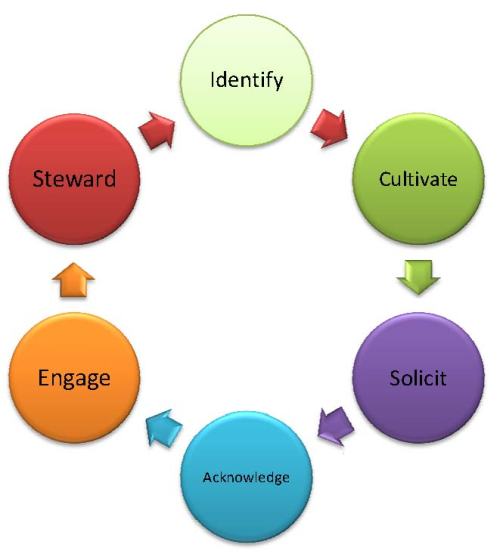
Fundraising Cycle - More Than Asking for Money

Fundraising Cycle - More Than Asking for Money

Now more than ever many organizations are looking closely at their fundraising programs. Leadership expects the fundraising department to do more, often with less.

Organizations and institutions are being challenged in new ways and development departments are facing new demands.

One of those demands is to move away from development to focus more exclusively on fundraising. Development is the long term process that includes fundraising. It also includes identification, cultivation, solicitation, acknowledgement, engagement and stewardship.

In these times you may feel the pressure to focus on bringing in the money and may be asked to ignore the larger part of the development cycle. But you may be cannibalizing your development and fundraising function in the process.

Identification is the process of identifying individuals with the interest and financial means to support your organization.

Cultivation is the process of getting to know your prospective donors and letting them get to know your institution.

Solicitation is when you ask for money. This is the one piece of the process that is sometimes mistakenly seen as the whole. But it is only one part. Solicitation can take place by mail, on the internet, in person, from the pulpit if your organization is a church, or at an event. You can ask an individual for a specific amount, provide a range of options, or simply let them determine what they can give. Solicitation also takes place when you submit a proposal to a foundation, corporation or funding agency.

Acknowledgement is when you thank and acknowledge donors for their gifts. This includes sending thank you letters and tax receipts, and including gift acknowledgements in your annual report or newsletter.

Engagement brings your donors closer into the life of your institution. Many donors can give more than money. They can give their time, provide technical expertise, help secure resources and services at reduced prices or advocate on your behalf.

Stewardship keeps you in relationship with your donors. You think about them at times other than when you are in need of money. You invite them to events, keep them updated on your organization’s programs, successes and challenges. 

As you can see, fundraising is just one part of development. Don’t try to save money by treating your donors as an ATM machine. Remember to focus on all the steps in the development process.

Learn more about fundraising

Copyright 2009 – Mel and Pearl Shaw

I’ll take a percentage

Fundraising ethics - something to consider

Imagine this. Your nonprofit organization is short on funds. A former co-worker tells you she knows someone looking to give $25,000 to an organization like yours. She says, “I’ll introduce you and facilitate the process if you give me 10 percent of whatever she gives you. You know, a finder’s fee.”

Or what about this. Your neighbor says your organization is a perfect fit for grants being made by the Obama administration. He says, “I’ll write the grant. If you get it, you pay me 10 percent. If you don’t get it, you don’t have to pay me.”

What do you do?

The above scenarios might seem ideal. You don’t have to do anything and your organization will financially benefit. You don’t have to hire staff, engage board members or spend a lot of your own time trying to secure a gift that may or may not come through. Do you say yes or do you try to reposition the offer?

As appealing as it may seem, both of the scenarios violate the Association of Fundraising Professionals Code of Ethical Principles. That’s right. Fundraising is a profession and fundraisers have a professional association that develops ethics and monitors adherence.

Ethical standard 24 from the association’s code of ethics states, “Members shall not pay finder’s fees, commissions or percentage compensation based on contributions and shall take care to discourage their organizations from making such payments.”

Here is the reasoning. Raising funds for a nonprofit is about obtaining the resources needed to advance the organization’s charitable or social mission. Importance is placed on retaining the trust of donors and ensuring that funds are used to fulfill the agreed upon social mission. Percentage-based compensation and finder’s fees can give rise to betrayal of philanthropic trust in an attempt to secure a larger gift and related fee.

Also, most people don’t give because of the skill and talent of your fundraiser. They give because they had a positive interaction with someone associated with your organization or because of a belief in your work. For the above scenarios, ask your coworker if she would volunteer to make the introduction because she believes in the value and impact of your organization. Ask your neighbor if he would write the proposal for a flat fee or hourly rate. Fundraising relies on volunteers and paid staff or contractors. It’s okay to pay fundraisers. Just don’t pay percentages.

Learn more about fundraising ethics at www.afpnet.org/ethics.

Q&A with the East Bay Community Foundation

EBCF-logoThe East Bay Community Foundation has been bringing together philanthropists and non-profit organizations since 1928. We thought you might like to know a bit more about the foundation, so we posed some questions on your behalf.

What is the mission and vision of the East Bay Community Foundation?
Our mission is to be the organization of choice for philanthropy in the East Bay through leadership in leveraging all assets in our communities to speed the transformation of low-income, disadvantaged, impoverished, underserved and underrepresented people.

Our vision is to broker solutions to the East Bay’s most pressing problems, achieving measurable transformation or significant change in our communities.  We strive to be a vital resource of intelligence on the East Bay; to provide our own leadership for change and to help develop leadership capabilities among organizations working for similar change; to connect the needs of the East Bay to the interests and resources of our donors, our supporters, and of organizations working for change in our region; and to ensure our donors and supporters represent the diverse communities of the East Bay.

How is the current economic climate impacting the Foundation, its fundraising and grantmaking?

It provides a temporary but serious challenge to all three. As a result of difficult economic times, everyone is tightening their belts.  We have not decreased our grantmaking targets and we hope we aren’t compelled to in the future.  This is a time for people and organizations to step up, not step back.  

What percentage of your donors are people of color?

Many communities of color have a long heritage of charitable giving.  And we know from data that people of color, women, and younger people are involved in philanthropy in increasing numbers.  However, we don’t collect data on the ethnicity of our donors.

What percentage of Foundation grants go to organizations that serve communities of color?

100% of the grants over which we have complete discretion serve communities of color.
 
What advice do you have for staff and board members of local non-profits?

During these difficult times, find a local non-profit that has the same mission as you do or has a very similar one.  Partner with them or if necessary consider even merging with them.  This can be a way to reduce expenses and create potentially more effective service delivery systems.  That’s a tough message, but, many non-profits are facing unprecedented revenue short falls.  By combining forces with other organizations, many non-profits may be able to sustain critical services in our communities.

Learn more by visiting the East Bay Community Foundation online at www.ebcf.org

How diverse is your board?

How do you define diversity?The board of directors of a non-profit organization is responsible for the organization’s financial health. The board is also charged with hiring and evaluating the executive director, creating policies and procedures that guide the work of board and staff,  with articulating the organization’s mission and vision, and ensuring the organization has access to the funds it needs to deliver on its mission.

But who are these board members? Who is making decisions for the organizations we rely on and are engaged with? If you are a member of a church or other religious organization, attend or work at a community college, seek food from a local non-profit or food bank, visit a museum, ride the bus or visit a hospital you are interacting with one of the thousands of Bay Area non-profits. And each is governed by a board of directors. They are making decisions that impact which services are offered, how donated funds are used, which government grants are pursued, and ultimately how these organizations will help – or not help – individuals, families and communities.

Board members who govern public agencies such as transit authorities and community colleges are elected. Others such as board members of faith-based organizations, private colleges and grass roots organizations are selected by people who are already sitting on the board. Still others are elected by members of the organization. This is true of membership organizations such as the Sierra Club.

The composition of the board is increasingly important to funders, donors, staff and the very people served by an organization. But what is diversity? The San Francisco Foundation holds diversity as a core value that guides its work. They define diversity as “the range and variety of characteristics and beliefs of individuals that encompasses, but is not limited to, race, ethnicity, gender, gender identity, sexual orientation, disability, age, economic class, immigration status, and religious belief.”

Here is our question for your organization – how do you balance your board’s membership? How do you ensure your board represents the people you serve? That it also includes people with access to wealth and decision makers? Do you engage individuals who can provide guidance in the areas of financial management, fundraising, personnel, and emerging trends in your content area? Are your board members required to conform to a specific viewpoint? Is agreeing with the board chair or executive director a requirement for membership? Each organization answers these questions differently. How does your organization give life to diversity?

© Copyright 2009 – Mel and Pearl Shaw

Cause marketing – everyone wins

Subaru

Subaru cause marketing a win-win-win

Cause marketing is one way for businesses and non-profit organizations to partner with each other to create value, generate revenue and increase visibility.

Here’s a real life example.

In November we leased a Subaru Legacy. We love it! Great car. Great lease price. Meets all our needs and those of our new dog. In our search for a new vehicle Mel spent months test driving cars and negotiating lease prices. We found the Legacy by chance. We drove by a Subaru dealership on our way to the movies and saw a Legacy out front with a sign that said $199/month.

Well that’s a great price. And Mel said it’s top rated by Car & Driver magazine. We were sold. But we got more than we bargained for. The dealer told us that with our lease Subaru would give $250 to a non-profit of our choosing.

It turns out that Subaru was running a cause marketing campaign. They had selected five non-profits that are aligned with the values of their customers. A niche marketer, Subaru knows that its customers have active lifestyles, are technologically sophisticated, and champion environmental issues and education. In fact, Subaru is the official vehicle of more than 20 non-profit outdoor and professional organizations. Subaru knows who buys their cars and they created a marketing campaign that addressed the desire of Subaru owners to help worthy causes.

The five charities selected were Boys and Girls Clubs of America, Habitat for Humanity International, Meals on Wheels Association of America, National Wildlife Federation and the American Society for the Prevention of Cruelty to Animals. Subaru gave $4,686,750 to these organizations. Checks were presented on February 12th at the Chicago Auto Show. Subaru gave away over $4.5 million and yet it was in the black financially while Ford, General Motors, Chrysler and even Toyota and Honda finished in the red.

As another example of how well this program was run we received a letter from Meals on Wheels Association of America thanking us for designating their organization when we bought our car. In their letter they clearly communicated how important local Meals on Wheels programs are to individual seniors and how the Meals on Wheels Association of America is important to local Meals on Wheel programs.

We leased a car. Subaru increased its revenue. Seniors across America are receiving meals delivered to their doors. Cause marketing at its best.

Copyright 2009 – Mel and Pearl Shaw

Help is on the way

San Francisco Foundation logo

San Francisco Foundation's new non-profit transitions fund

If your organization is grappling with whether or not to merge with another organization or close altogether, you are not alone. The current economic climate is posing many challenges to the very existence of some organizations. For many donations are down, grants are smaller or postponed, and government funding that used to be relied on may simply no longer be available.

If your organization is grappling with difficult issues due to the downturn in the economy, there is help. The San Francisco Foundation has created a new fund called the Nonprofit Transitions Fund to help organizations reduce costs, increase productivity, merge, dissolve, or reorganize. The following is a list of the activities they are prepared to support.

  • Back office collaborations (including rent, equipment, group insurance joint purchasing, and centralizing human resources, payroll, and benefits administration and financial and grants management). Such collaborations can reduce operating and administrative costs.
  • Merger, acquisition or consolidation
  • Dissolution (voluntary/involuntary)
  • Bankruptcy or reorganization
  • Post-merger integration or closure costs
  • Service delivery joint ventures

If your organization would benefit from any of these activities you may want to consider completing the Foundation’s short and straightforward application form. You will be asked to identify which activity your organization is considering, the efforts you have already made in pursuing such an option, and what condition or situation is triggering this consideration. The application is online at http://www.sff.org or you can call (415) 733-8527.

All applications will be reviewed and select organizations will be asked to submit a more detailed proposal. That proposal will ask you to communicate information such as:

  • Evidence of buy-in from staff, board, and constituencies
  • Clear and realistic expectations of benefits/risks
  • What niche or role your organization(s) serves locally or regionally
  • An understanding of your organization’s relative competitive position and its financial strengths

If you are considering a merger, the Foundation will want to know about mission compatibility between the two or more organizations and the extent of a cultural fit, including board and staff compatibility. You should also be prepared to communicate your awareness of obstacles such as asset restrictions, endowment/bequest issues, current liabilities, deferred revenue, and other legal barriers.

While economic conditions may be the driving force behind these considerations, some organizations may become stronger and more effective by pursuing difficult choices.

There are a lot of things to consider and help is available.

Copyright 2009 – Mel and Pearl Shaw

Perspectives on philanthropy

Cedric Brown - Director, Mitchell Kapor Foundation

Cedric Brown - Director, Mitchell Kapor Foundation

Changes in the economy, the stock market and employment rates impact non-profit organizations and the foundations that provide funding to them. We posed a few questions to Cedric Brown, director of the Mitchell Kapor Foundation related to these changes.

1. How is the current economic climate impacting giving by Foundations?
The endowments and total assets of many foundations have “taken a hit,” a term I’ve heard repeatedly around the philanthropic community. This means that many foundations, like nonprofits, are re-examining and scaling back to most-essential programs and administration.
The recession has had a mixed effect on the grant monies that foundations are giving out – some funders are scaling back, while others see the need to make even more grants in order to help nonprofit organizations to sustain their work in these uncertain times.

2. What gets your attention in a positive way when you are reviewing proposals?
The best grant requests are concise, giving as much information as possible in as few words as possible. Additionally, I appreciate grant requests that outline the overlap between the grantseeker’s work and the funder’s priorities. I’m also intrigued by new ideas, in thoughtful expansion plans for effective work, and in collaborations between organizations.

3. What gets your attention in a negative way when you are reviewing proposals?
It’s vital to read the funder’s guidelines and follow the directions! I’ll admit that I initially scan grant requests to make sure that the work aligns with our funding priorities. If it’s off, I’ll know in a matter of seconds and will discard the grant request. I’m also biased against typos, poorly-written requests, and overly-written requests – that is, proposals stuffed with lingo and flowerly language.

4. What is the one piece of advice that you would offer to a non-profit that is considering applying for a grant?
I advise nonprofits to do three things before applying: 1) read the potential funder’s website to learn about their funding priorities and their application process; 2) call a program officer to briefly discuss whether or not your work is a good match for the foundation (and don’t try to make it fit if it isn’t); and 3) have someone else read and edit your written materials to make sure that it sounds coherent before submitting it to a funder.

5. What is an example of a project you funded that exceeded expectations?
We work with so many fantastic organizations that I’m hard-pressed to choose one. Overall I’ll say that my grantmaking has largely been an investment in dynamic and competent leadership combined with a solid work plan. So in this respect, nothing has surprised me.

I am pleased, though, that we were an early supporter of Van Jones’ work on green jobs (through Ella Baker Center and Green for All), which he’s taken from Oakland to the New York Times bestseller list to the White House!

 6. What would happen if an organization did not accomplish what it said it would do when applying for a grant? Does that automatically mean they could not get another grant? How is this handled?
While I believe in accountability, I also believe in being flexible and reasonable. Nonprofits (and foundations, too, for that matter) are subjected to changing information and conditions that can re-shape their ability to accomplish their original goals. I think adaptability is an important trait to possess, allowing community organizations to appropriately adjust their work and expectations. But it’s critical for nonprofits to talk with their funders about substantial changes, not to seek “permission” or to “spin” (which is very transparent and annoying), but to say “This is what we’ve encountered and this is our response. What advice do you have to give us?” This way the nonprofit can appropriately involve the funder in the re-strategizing.

In my experience, the majority of nonprofits accomplish much of what they set out to do. It may be a different product in the end, but most do good and worthy work. Of course, there are the occasional “wayward” organizations; I have no qualms about cutting them off and chalking it up to a lesson learned about what NOT to do.

7. Are there any other comments or information you would like to share with our readers?
Small, startup nonprofits are going to have a very difficult time securing support in this economy. There’s a feeling in the nonprofit and foundation sectors that too many nonprofits exist. My best advice is that if you’re thinking about starting a nonprofit, first make absolutely sure that nobody else is doing what you’re proposing to do. If there are similar programs, ask how you might work with them to help deepen or expand their reach, rather than starting a new effort altogether.

Learn more about the Mitchell Kapor Foundation at www.mkf.org.

College President Runs Fundraising Marathon in the South Pole

President Delbert Baker - Oakwood University

President Delbert Baker - Oakwood University

What’s unique about your organization or institution? Do you know how to take advantage of your uniqueness and your passion and share it with others? Oakwood University (UNCF) in Huntsville, Alabama knows how. The university’s president Dr. Delbert Baker, born in Oakland, is a 56 year old marathon runner. Maybe you are a marathon runner too. But have you – or anyone you know – used your passion to create a unique international fundraiser?

Baker and Oakwood University have created a Running for Scholarships campaign. The president has pledged to run a marathon in every state of the United States of America, and on every continent under the slogans of “50 States for Students” and “Seven Continents for Students.” Each race is underwritten by the Florida Hospital’s CREATION Health Model, allowing every penny raised to go to Oakwood University student scholarships and endowment. Every penny.

The unique fundraising program raises awareness about the importance of health and it is raising awareness (and funds) for the University and providing Florida Hospital with a unique promotional opportunity. Other organizations and businesses are sponsoring the marathons and Baker wears their logos on his running outfits. The program is so successful that 16 out of the 17 potential sponsors who were asked to participate said yes.

And these are not “easy” marathons. At the end of December Baker successfully completed the Antarctic Ice Marathon (AIM) in Antarctica running in temperatures of -12°C. He finished the race in just under seven hours, clocking in at 6 hours, 53 minutes, and 15 seconds.

Baker described the race as “beautiful and brutal,” remarking that it was the most difficult event he had ever attempted. He noted that this success was possible only with the inspiration of his wife, Susan, the students, faculty, and staff of Oakwood University, and the generous donors who pledged more than $80,000 in scholarship and endowment funds for the Running for Scholarships Endowment, if Baker completed the race.

With the completion of the AIM, Baker has successfully completed 6 marathons on 7 continents and 28 marathons in 50 states.

What is your passion? What is unique about your organization or institution? What about the people you work with? Anything unique about your board chair or CEO? Put on your thinking cap and get ready for 2009. It is time to be creative, to think outside the box, to partner, and to offer value to all parties.

© Copyright 2009 Mel and Pearl Shaw.

Take a Page from the President’s Playbook

Take a Page from the President!

Take a Page from the President!

Did President Barack Obama pick all his cabinet members in one day? Did he pick people who share the same political beliefs as he does on all issues?

No. Obama took his time and picked people he felt bring specific experience, skills and connections needed to help lead our country and make decisions that will change the conditions of our individual and collective lives. He picked people with a commitment and dedication to service. Continue reading