
Category Archives: FUNdraising Good Times

Fundraising commentary, tips and information.

How to brand your business & support a nonprofit

Women Business owners

Woman and minority owned businesses can benefit from well-defined relationships with select nonprofits.

Partnering with nonprofits makes good business sense for emerging and established woman or minority-owned businesses. Board service puts a human face on your business; donating goods and services extends your brand. Creating a culture of philanthropy helps your business better compete for well-educated potential employees seeking a meaningful career and the opportunity to give back. Building a brand that communicates “we” instead of “me” opens the door to new networks and relationships that can help you meet your business objectives.

Other benefits include increased exposure to people of different cultures, races, ethnicities, geographic areas and professions; and learning from diverse leaders in a most intimate setting: that of a nonprofit grappling with management, marketing, or budgetary issues.

People who are involved with nonprofits are civic-minded people who are willing to open doors for others, and to extend their network. They will have the opportunity work with you, get to know you, and refer your business. You can extend similar opportunities.

Be strategic about your involvement. Engage with nonprofits that impact or are supported by your customer/client base, and the community you operate in. Customers and clients are more loyal to businesses that engage with nonprofits they believe in. Find out which nonprofits resonate with your clients/customers; look for those with similar values; evaluate how they could help you meet your business objectives. Interview the leadership of potential partners to learn their expectations of your business, and the opportunities they could provide. Done right, nonprofit service, sponsorship, and underwriting are cost-effective ways to build, sustain and expand a brand.

Things to consider. Identify a specific nonprofit to support with time, talent and finances over a multi-year period. Make the selection in collaboration with your leadership and employees. Increase your impact with planning and preparation. For example, identify what you want to achieve for your business, the nonprofit and the community. Determine how much money and time will you invest annually. Where will the money come from? Who will give their time? How do these numbers match to your nonprofit partner’s expectations?

Encourage employee giving. Implement a “matching gift program” that matches employee giving dollar-for-dollar up to a set amount each year. Encourage “on the clock” volunteering by employees. Incentivize customers and clients to support your nonprofit partner with time and money.

Include your nonprofit partnership strategy in your business plan to help ensure your business follows through on commitments. Over-deliver on your promises. Attend meetings and actively participate. Make an annual gift. Purchase a table at all events. Take advantage of sponsorship and underwriting opportunities. Ask other businesses to “meet or beat” your contribution. You demonstrate leadership – and increase your impact – when you engage other businesses in the work of your nonprofit partner.

Mel and Pearl Shaw are the authors of “Prerequisites for Fundraising Success” and “The Fundraiser’s Guide to Soliciting Gifts.”  They provide fundraising counsel to nonprofits. Visit them at www.saadandshaw.com. Follow them @saadshaw.

The Impact of Mobile Devices at meetings

An example of a Digital Conversation being run...

Who is more important: you or a group of your fellow nonprofit volunteers or professionals? What signal are you sending when you direct your attention to your mobile device instead of the group’s discussion? If you believe the work of the organization or institution is unimportant, say so and work with your peers to restructure meetings. If not, give your attention to the business at hand. Each of you has carved out time from your busy schedules to attend the meeting: make the most of it.

For many, time is now considered a resource even more valuable than money. Increasing demands on our time from work, family and volunteer commitments make it all the more important that time allocated for meetings be most productive. As nonprofit professionals are asked to take on more responsibilities the time dedicated to staff meetings becomes even more valuable. Checking your mobile device removes your attention from the discussion at hand. Your knowledge, expertise and insights are removed from the conversation. The opportunity for synergistic thinking, problem solving and strategizing diminishes as participants mentally enter and leave the group’s work with a glance at their device.

And then there’s hurt feelings. Some people are offended when they are talking and others are texting or checking email. The sentiment can be, “Why should I bother if they aren’t interested?” The result can be a process of gradual or immediate disengagement.

Observe your behavior and that of others in the next meeting you attend. How often do people check their devices? What is accomplished in the meeting? Ask reflective questions of yourself and others in the room: are our meetings boring? Too long? Are they structured to take advantage of the best thinking in the room? Are people coming prepared to meetings? When are people checking their devices and does that correlate to the discussion at hand?

Make sure your meetings are worthy of the time you ask each person to give. Develop a protocol for the use of mobile devices. One corporate board asks members to place devices in a basket upon entering the meeting, and provides breaks for the purpose of checking calls and messages. Your nonprofit is as important as a corporate board. Reach agreement regarding the use of devices and hold each other accountable. Remind people of the policy when meetings are being scheduled, and again at the beginning of each meeting.

You can use mobile devices to help advance the organizations you are involved with. Engaging and updating friends, colleagues, donors and supporters via Facebook, twitter, LinkedIn, Pinterest or Instagram increases the organization’s social media presence and reach. The same with calling and emailing to set appointments and provide updates. Mobile devices bring us together. Don’t let them drive us apart.

Mel and Pearl Shaw are the authors of “Prerequisites for Fundraising Success” and “The Fundraiser’s Guide to Soliciting Gifts.”  They provide fundraising counsel to nonprofits. Visit them at www.saadandshaw.com. Follow them @saadshaw.

Preparing to Ask for a Gift

Making the Ask-Part Two

Preparing to Ask for a Gift-Saad & Shaw

Fundraising provides nonprofits with the money they need to deliver on their missions. When you ask others to join you in giving you become part of the nonprofit’s success team.

In part one of this series we discussed how to prepare to solicit a gift. In this column we cover setting the appointment and what to say when asking.

Here’s what we believe: asking for a gift should be done in person whenever possible. Make an appointment to talk with your colleague, family member or friend about giving. Let’s use an example of asking Jesse for a gift. “Jesse, would you have time to meet with me about All In For Children? I am committed to working with them to raise money for their new programs and I want to share that information with you and explore how you would like to be involved.” All you want from the conversation is a time to meet. If Jesse says, “Oh, we don’t have to meet. Put me down for $100,” you can respond with, “I understand. Would you make some time for me just the same? You might want to give even more after we talk!” Keep the conversation light, but get that appointment.

As you prepare for your meeting, make sure you have brochures or online information you can share. Practice your presentation. You will want to talk about the organization’s history, current activities and vision for the future. You will also want to cover what specifically you are raising money for and how the money will be used. Be prepared to communicate using emotion and facts.  Talk about what the organization means to you and why you are involved.

During the solicitation be sure to ask for a specific, reasonable and challenging gift.  Know the amount you will ask for.  It shouldn’t be too small an amount, nor too large.  Remember to talk about the gift you made.  If your gift is similar to what you would like your prospect to give, state the amount you gave and why.

Always remember to make the ask. Be very clear and specific when asking: “Jesse, I would like for you to make a gift to All In For Children.  Would you be willing to contribute $___?”

Pause after you ask for the gift.  Do not rush to fill the silence.  Give Jesse time to respond, for he will. If he says “yes”, thank him and ask how he would like to make his gift. If he says “no”, ask what would be the right amount at this time. If Jesse says this is not the right time, ask what would be a good time. Regardless of the outcome, thank him for his time. After the meeting, send a thank you note.  You can do it! Your nonprofit depends on you.

Get all the details in “The Fundraiser’s Guide to Soliciting Gifts.” 

Mel and Pearl Shaw are the authors of “Prerequisites for Fundraising Success” and “The Fundraiser’s Guide to Soliciting Gifts.”  They provide fundraising counsel to nonprofits. Visit them at www.saadandshaw.com. Follow them @saadshaw.

How to Solicit a Gift

Making the Ask – Part One

Money

How do you ask someone to make a gift to a nonprofit that you believe in? What do you say? When do you ask? What if the person says “yes?” What if she says “no?”

When it comes to soliciting a gift for a nonprofit here’s what you need to know. First off, if you are new to fundraising, it is natural – and healthy! – to feel a bit nervous. One way to reduce nervousness is to prepare and rehearse. Think about what might encourage a potential donor to give, and what his or her objections might be. Be prepared to overcome potential objections with information. And don’t worry – the most important thing is to ask. You can’t predict the response, but you can prepare your presentation. And, once you start getting a few “yeses” you may get addicted to fundraising: it is fun to secure resources for organizations and institutions you believe in.

Here are a few suggestions for getting started. First off, don’t work alone. If you are asked to solicit a gift for a nonprofit, college, or hospital ask who on the staff will work with you to get you prepared. When you meet with the staff person be sure to discuss who you should solicit. You may have several people in mind, the organization may also have a few people they would like for you to ask. In general, you should solicit people you know or have a relationship with.

You will want to learn about the relationship between the organization and the people you will be soliciting. For example, will you be soliciting current donors or volunteers, or people who don’t yet have a relationship with the nonprofit? You will want to know how much money the organization is seeking to raise in total, how much has already been raised, as well as what size gift you should ask your prospective donor to give. Make sure that you have access to printed and online information about the organization, its mission, vision, impact, programs and leadership. Ask for a brochure to take with you. Be sure you can communicate how the funds raised will be used. Ask as many questions as you feel the donor may have. It is most important that you are both knowledgeable about the organization and comfortable answering questions that may arise.

If you are new to fundraising, or feel uncomfortable making the ask, request that the staff person spend some time role playing with you. You may also want to accompany a staff person or more experienced volunteer or board member as they solicit a gift. This can help decrease any nervousness or discomfort you may feel.

Most importantly – make your own gift before you ask someone else to give!

Next week: details on what to say when soliciting a gift.

Mel and Pearl Shaw are the authors of “Prerequisites for Fundraising Success” and “The Fundraiser’s Guide to Soliciting Gifts.”  They provide fundraising counsel to nonprofits. Visit them at www.saadandshaw.com. Follow them @saadshaw.

You might be a grant writer if…

GrantWritingFor those considering new career paths, this blog post will give you food for thought. Here’s what we know: if you can write clear and compelling proposals you will be in-demand.Check out You might be a grant writer if….

The Power of Women Fundraisers

 Dr. Johnnetta Cole, Director of the Smithsonian's National Museum of African Art. Fundraising Role Model.

Dr. Johnnetta Cole, Director of the Smithsonian’s National Museum of African Art. Fundraising Role Model.

Women are role models in so many sectors of our economy, and the nonprofit sector is no exception. In honor of women’s history month we salute women who step up to the challenge of raising money for nonprofit organizations and institutions they believe in. Their leadership and vision impact the lives of individuals, families, communities, regions and our nation as a whole.

We want to encourage more women to become fundraisers, and to grow their fund development capabilities. We want women to seek fundraising positions at the highest levels, and to inspire their peers to join them.

We share with you the characteristics we have observed amongst successful women fundraisers. The following are by no means definitive, or exclusive: they are simply based on our observations over the years.

First and foremost successful women fundraisers are not afraid to ask. They are fearless in asking for money, resources, guidance, help and time. They are confident in who they are as a person, and are not intimidated by people of power, wealth and influence. They are risk takers who are not afraid to fail. At the same time they always have a “plan b” and a “plan c” in case their original plan falters.

Speaking of plans, they are big on planning. They pay attention to detail, and they excel at follow-through. They are well prepared, and don’t “wing it.” They are collaborators who look for opportunities that will advance their donors, board members and volunteers.

They truly like people and seek to bring people together to advance organizations they believe in. When they bring people together they know how to manage them, how to bring out their best talents and abilities. Their passion is real: it’s not something they are paid to project. Rather, their leadership springs from their belief in the mission and vision of the organizations they are involved with.

Talented fundraisers we have known are listeners. They are willing – and able – to listen more than they talk. On the whole, they live a balanced lifestyle and are energized: they exude an energy you can feel. They attend to their physical and emotional health knowing that doing so gives them an edge. They are big on professional development and growth for themselves and the teams they manage. They are not satisfied with current success.

They have no problem sharing the limelight. They are willing to take a back seat and let others enjoy the limelight, for they know that their success lies in donors and volunteers giving and giving generously. They love the challenges of fundraising, and have no issues talking about money. They understand that they are facilitators and not the focal point. Successful fundraisers are valued and in high demand. They orchestrate leadership teams who secure the money and resources that bring the visions of nonprofits to life. We salute you!

Mel and Pearl Shaw are the authors of “Prerequisites for Fundraising Success” and “The Fundraiser’s Guide to Soliciting Gifts.”  They provide fundraising counsel to nonprofits. Visit them at www.saadandshaw.com. Follow them @saadshaw.
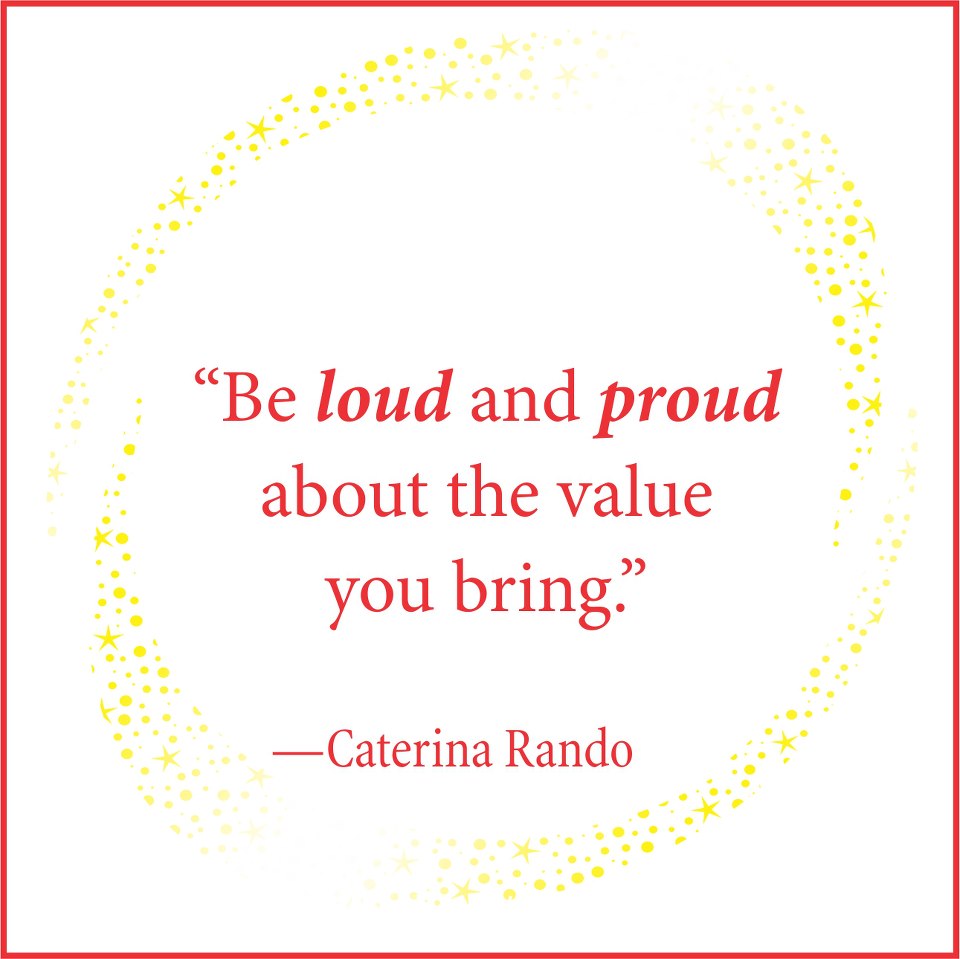
Be Loud and Proud for More Business

In case you didn’t know, March is Women’s History month. We know women make history each day as fundraisers, philanthropists, businesswomen, volunteers, artists… We make history every day in every realm. To celebrate women business owners we asked Caterina Rando, a talented business coach and entrepreneur for her observations.

LoudAndProudThere are two very different and distinct groups of people: the Loud and Proud and the Keep it Quiet.

The Loud and Proud business go out of their way to meet people, share their expertise, speak, write and let people know what they do and the value they bring. They are friendly, always wear a smile, always look good because they are dressed for an insta-connection, a chance meeting or an unplanned conversation with a new potential donor at any moment.

Then there are the Keep it Quiets. They do not go out of their way to meet new people or to let people know about the value they bring. When asked what they do they do not respond succinctly with clarity and confidence.

Do you say you want to accomplish more in private and yet you are quiet about the value you bring to your potential clients/donors in public online and off?

Whatever your answer here are a few more things you can do to proclaim to the world that you are loud and proud and you have value to bring.

  1.  Your phone message enthusiastically talks about your business/mission and the value you bring.
  2.  Your email signature includes your phone number, email and website and any special events or promotions you are currently offering.
  3.  You are loud and proud about the value you bring on your Facebook and LinkedIn. You post your successes and those of your clients.
  4.  *You host your own events to connect with your clients, potential clients and community to provide them some value and connect with them live and in person.
  5.  You host a free webinar or teleclass regularly to share your value with new people and grow your list.
  6.  You write regularly of online or offline publications, you proliferate your articles and keep up with your blog. More importantly you get the word out about it.

Now that you have gotten some ideas ask yourself what you are going to do to be more loud and proud. The louder and prouder you are about the value you bring the more your business will thrive!

Caterina Rando’s life work is showing entrepreneurs how to be loud and proud about who they are and the value they bring. She shares ways to build a thriving business using public speaking, getting published and building your expert platform.

Download your free audio on How to Be A Sought After Speaker at http://www.soughtafterspeaker.com. Caterina can be reached at Cat@caterinarando.com or by phone at 415 668-4535.

Lean in for nonprofit leadership

“Lean in” for leadership in a nonprofit career

SherylSandbergLeanInWeb Sheryl Sandberg, the chief operating officer of Facebook has a new book out.  “Lean In” has generated a lot of media attention. It’s all about women and leadership in the business world. Bottom line: she encourages women to seek leadership-level positions. Listening to the news stories we asked ourselves, “what about the nonprofit sector?”

What does it take to advance to leadership level positions in the nonprofit sector? Our experience has shown that fundraising experience is an important prerequisite for securing an executive position and most importantly for remaining in the position. Related to this is an understanding of fund development and the ability to manage a fundraising operation. These are not the only prerequisite, but it is an important one that is too often overlooked.

If you are working for a nonprofit and want to progress in your career, make your intentions known and begin to prepare yourself. Our guidance relates to building your fundraising skills and network. Here’s why: securing funds from philanthropic sources is often times the primary revenue stream for a nonprofit. Even those funded through government grants or contracts, or through earned income streams, find that philanthropic funding is what makes the difference between a “just getting by” institution and a thriving one. The willingness to raise funds and build a fundraising team provides an organization with the funding and resources it needs.

Lean in and prepare yourself to be a leader. Develop career goals that include responsibility for fundraising. Learn about the different types of fundraising and how they work together. Invest in your education and training. Participate in online and in-person training sessions that expose you to new areas of fundraising and ones that deepen your current skill set. If your employer won’t invest in your professional development, make the investment yourself. Network with people you meet at conferences or online. Ask questions of those who are more experienced. Ask someone from a similar type of organization in another part of the country for a critique of a fundraising project you are working on. Read journals, books and blogs. Get a mentor.

If you don’t currently work for a major nonprofit institution, consider becoming a fundraising volunteer for a local hospital, university or public television station. These institutions typically have more robust fundraising programs than grassroots or mid-sized organizations and can provide exposure to campaigns that include major gift solicitations, annual gifts, special events, direct mail, planned gifts, underwriting and other fundraising programs. You will find opportunities to grow your skills and your network.

Most importantly make it known that you want to learn more about fundraising. Most people don’t embrace fundraising. That’s a mistake you don’t have to make. Lean in and you will find opportunities to learn and ultimately to lead.

Mel and Pearl Shaw are the authors of “Prerequisites for Fundraising Success” and “The Fundraiser’s Guide to Soliciting Gifts.”  They provide fundraising counsel to nonprofits. Visit them at www.saadandshaw.com. Follow them @saadshaw.

Shine a light on your fundraising

Team building – a secret to fundraisings success

Part two of a two-part series

TeamworkIt’s all about leadership and team building. You’ve heard the refrain, but what does it mean? In terms of nonprofit fundraising there can be no greater mandate than leadership and teamwork. Scarce funding for staff positions, stiff competition for the philanthropic dollar, and an abundance of wishful thinking leaves nonprofits at risk of not meeting their fundraising goals. Building and supporting a volunteer-led fundraising team is one way out of the vicious cycle imperiling too many organizations.

Your fundraising team should be comprised of leaders who are committed to ensuring your nonprofit has the money and resources it needs to deliver on its mission. It should include your volunteers, staff, executive leadership and board members. All members should work from a fundraising plan. You can have a simple plan or a complex plan. The most important thing is to work from a plan with agreed upon financial goals, timeframes, and defined roles and responsibilities. For a team to function, everyone has to know their role, and be qualified to fill it. Invite people to join your leadership team based on their understanding of what you are trying to achieve and how well they can help implement your plan.

Your team will set the tone, policy, and direction of your fundraising and monitor its progress. The committee should be led by a fundraising chair or co-chairs. These volunteers should be supported by the institution’s chief development officer and executive director. If you don’t have a fundraising chair, you need one. Take the time to review your fundraising plan, identify who could best help you meet your goals, and then find the right person to talk with your potential chair, inviting him to provide leadership. Be sure to show him your fundraising plan: people are more likely to say yes when they see you have a plan in place to meet your goal.

Other potential members for this committee include board members, current major donors, community and business leaders, key stakeholders, your finance director, executive director, development director and program staff.

Your fundraising chairs should convene and lead your monthly meetings. Team members should report on specific actions they have taken, solicitations, proposal submissions, and new potential donors and funders who have been identified. Staff should provide reports showing progress against goal, number of gifts received, average size of gift, largest gift, and specific information that allows the team to make proactive fundraising management decisions.

Team meetings shine a light on what people are doing and not doing. It holds board members, staff and volunteers accountable to each other. It takes away excuses and when things are going well it creates an excitement and momentum that is contagious.

Raising money is too important to go alone. Build and nurture your team.

Mel and Pearl Shaw are the authors of “Prerequisites for Fundraising Success” and “The Fundraiser’s Guide to Soliciting Gifts.”  They provide fundraising counsel to nonprofits. Visit them at www.saadandshaw.com. Follow them @saadshaw.