Monthly Archives: February 2013

Who will solve your fundraising problems?

Team building – a secret to fundraisings success

Part one of a two-part series

A group of Individual Placement members enjoy ...

Will hiring a fundraising professional solve your fundraising challenges? Is it your secret wish that someone will take care of fundraising so you can focus on the “more important” work of your nonprofit? Perhaps you seek a million dollar bequest from an unknown admirer.

Here’s the real secret to sustained fundraising success: create and support a fundraising team that meets regularly and “owns” your fundraising. That’s it. You can’t do it on your own. No one person can solve all your challenges. You have to build and grow a team that includes your volunteers, staff, executive leadership and board members. Your team should be comprised of leaders who are committed to ensuring your nonprofit has the money and resources it needs to deliver on its mission.

Here are the benefits. A fundraising leadership team helps create accountability and transparency. Members are accountable to each other. Each member knows the commitments, roles, and responsibilities of all other members. There are no secrets. If there is a lull in gifts received, the full team knows about it. When new gifts are received, members know about it. When fundraising management reports are shared at each meeting, team members can monitor the progress of fundraising activities, ask pertinent questions, and work with each other to create new strategies and work-arounds.

Your team should meet on a regular basis to report progress and challenges. Members should work collaboratively to help your organization reach its fundraising goal. They should be empowered to make decisions, and the decisions made by this team should be respected and implemented by fundraising volunteers and employees.

With a strong fundraising leadership team, the actions of staff, board members, and volunteers are open to review by team members. Financial progress and expenses are reported regularly at these meetings. Members have the opportunity to share information and coordinate their activities.

When you have engaged qualified volunteers to assist with fundraising, you will be amazed at the solutions they come up with. The key to an effective fundraising leadership team is for it to be volunteer-led with support from staff. That means the fundraising chair leads the team meetings, not the executive director or chief development officer. It means that staff support the work of the fundraising chair by producing and distributing fundraising reports and taking and quickly distributing minutes that accurately capture action items and next steps. If you have selected a qualified fundraising chair and clearly defined his responsibilities, you will be amazed how he can assist you in meeting your goals. He can do this because he has made them his goals. He is no longer helping your organization; he is now orchestrating and attracting people and resources for something he believes in.

Next week: team membership and meetings

Mel and Pearl Shaw are the authors of “Prerequisites for Fundraising Success” and “The Fundraiser’s Guide to Soliciting Gifts.”  They provide fundraising counsel to nonprofits. Visit them at www.saadandshaw.com. Follow them @saadshaw.
UNCF telethon: a black history game changer

UNCF telethon: a black history game changer

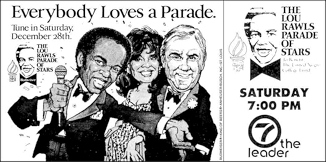
UNCF Telethon Parade of StarsLights, camera, action. In 1980 the United Negro College Fund, UNCF, launched the Parade of Stars telethon. It became a nationwide fundraising program raising millions of dollars for generations of students, and support for historically black colleges and universities. It became the largest one-day African American special event in the country. It changed black history – and American history – creating an acknowledged culture of fundraising in the African American community. America’s largest corporations became engaged. Small churches, teachers, sororities and fraternities became engaged. Donors and volunteers from across the country organized to support UNCF and celebrate black philanthropy.

Here’s the back story. The telethon actually began years earlier in Dallas, Texas. The first telethon was a live performance at the Fairmont Hotel with STAX recording artists Rufus Thomas and Johnny Taylor backed by the Dallas symphony. The performance was filmed, edited and prepared for broadcast in 13 radio and television markets across Texas. Local volunteers answered phones and families across Texas called to give. A national fundraising movement was born.

The telethon gained national exposure in 1974 with hosts Nancy Wilson and Clifton Davis. Ron Bookman secured the talent; television and radio stations broadcast in select markets at no charge. This caught the attention of Anheuser-Busch and the rest is history. Lou Rawls, as spokesman for Anheuser-Busch, became the iconic host of the telethon. American Airlines, Kellogg, General Motors soon joined as sponsors and underwriters.

The telethon became a great recruiting tool for UNCF colleges. It also increased alumni pride and giving. It sent a message to corporations and foundations: UNCF colleges are important to African Americans and America. With an ear to the ground for the drumbeat of the community, these major funders joined with grassroots America to give – and give generously – to what became the “charity of choice” for African Americans. UNCF shed its image as an organization that appealed to the elite: it had launched a “people’s campaign” engaging donors and volunteers from all walks of life.

The telethon did what hadn’t been done before. It created a culture of fundraising throughout the black community that also engaged Hispanics, American Indians and Whites. It made UNCF a household word, and the phrase “A Mind is a Terrible Thing to Waste” one of America’s most iconic slogans. Corporations participated in cause-marketing focused on the black consumer. African Americans became the majority of UNCF donors, “documenting” their widespread support for the organization. The telethon provided an opportunity for all segments of the community to participate and be publicly recognized for their contributions. It provided economic opportunities for African American advertising agencies, marketing executives, producers, writers and small businesses. Most importantly it demonstrated the power of diverse volunteer-led fundraising. Our take: Think big, start small.

Mel and Pearl Shaw are the authors of “Prerequisites for Fundraising Success” and “The Fundraiser’s Guide to Soliciting Gifts.”  They provide fundraising counsel to nonprofits. Visit them at www.saadandshaw.com. Follow them @saadshaw.

Saluting Dr. Patterson founder of the UNCF

Dr. Patterson of UNCFBlack History Month celebrations are incomplete without a salute to nationally recognized fundraiser Dr. Frederick Douglass Patterson, founder of the United Negro College Fund. Named for abolitionist Frederick Douglass, Dr. Patterson was committed not only to fundraising but to collective fundraising that has changed the lives of generations of African Americans

Born in 1901, orphaned at age two, and raised by his sister Patterson earned a teaching certificate from Prairie View Normal and Industrial Institute in Texas by age 14; and a doctorate in veterinary science by age 22 and a master of science degree by age 27 both from Iowa State university. At 32 he earned a second doctorate from Cornell University. At 34 he began his tenure as the third president of Tuskegee Institute, a position he held for 25 years. As president Dr. Patterson established the university’s School of Veterinary Science and continued the institute’s strong fundraising tradition begun by its founder Dr. Booker T. Washington. He also authored the weekly column The Southern Viewpoint published in the Pittsburgh Courier.

On Saturday January 30, 1943 Dr. Patterson published his thoughts on the need for collective fundraising to benefit private black colleges with the title “Would it not be wise for some Negro schools to make joint appeals to public for funds?” And so it began. In 1944 Dr. Patterson founded the United Negro College Fund and launched the first national campaign to raise funds for twenty seven private, historically black colleges and universities from across the south serving 12,000 students with income of $765,000.

Fast forward to today and UNCF has raised more than $3.3 billion, almost $1.5 billion of which has been raised in the past decade alone, to enable more than 400,000 deserving students to earn the college degrees they want and need but might not otherwise be able to afford. The organization is ranked among the top ten charitable organizations in the country by The Non-Profit Times and The Chronicle of Philanthropy.

Dr. Patterson could have focused his energies on raising funds for Tuskegee. Instead he was unselfish in his commitment to access to higher education for African Americans. In addition to founding UNCF Dr. Patterson founded the College Endowment Funding Plan for which he was awarded the Presidential Medal of Freedom by President Ronald Reagan in 1987. The CEFP raised over $60 million for 36 participating schools. He also served as president of the Phelps-Stokes Fund focused on African Americans and higher education.

He had a vision for both fundraising and social financing that leveraged private and public funding. From the very beginning he encouraged African Americans to give to HBCUs with his 1943 words “…such a campaign might well begin with Negro people of America.” It not only began, it continues.

We salute Dr. Patterson a visionary African American fundraiser who created one of the most well-known and well-respected fundraising organizations in the United States of America. The UNCF is a preeminent American organization known across the globe by its iconic slogan “A mind is a terrible thing to waste.”

Mel and Pearl Shaw are the authors of “Prerequisites for Fundraising Success” and “The Fundraiser’s Guide to Soliciting Gifts.”  They provide fundraising counsel to nonprofits. Visit them at www.saadandshaw.com. Follow then @saadshaw

Fundraising Starting Point: Commitment

Start

Commitment is at the heart of all successful nonprofit fundraising. It needs to be developed and sustained. It starts with the organization’s leadership – the executive director or CEO, board members, as well as leadership level employees and volunteers. The purpose and vision for proposed fundraising needs to be carefully discussed by these parties, ideally through one-on-one conversations with time for challenging questions and clear answers.

After individual conversations have occurred, dedicate time during board meetings for group discussion. Invite grappling with the proposed fundraising initiative, the asking of questions, and the raising of doubts. Encourage new ideas along with expressions of enthusiasm or caution. Allocate enough time for a full discussion. As appropriate, schedule a retreat focused on fundraising. Many organizations host such retreats annually. Others will host a retreat when planning for a capital campaign or other fundraising initiative of special significance. Always leave enough time for all parties to fully understand and commit to a proposed fundraising goal. This is the most important fundraising prerequisite — without full commitment, there is greater potential for fundraising challenges.

We also suggest the executive director set aside time for similar discussions with senior staff. Employees often have insights and suggestions that can positively transform fundraising – ideas that may not be accessible to the organization if they are not invited into the fundraising conversation. A staff retreat may be a good investment of time and resources.

You will also want to gain the support of your organization’s informal leadership — those stakeholders who have supported your organization over the years with their time, money, and talent. Ideally you will talk with major donors, your most consistent donors, and volunteers, consultants, and staff as you develop a fundraising initiative. Remember, fundraising requires more than money. Talking with your extended leadership will help engage the best thinking, involvement, creativity, and networks of those closest to your organization. These individuals can provide ideas and resources that extend beyond those you thought of originally.

Another thing to remember is that prospective donors and funders always ask about the involvement of key stakeholders, particularly board members. In fact, many will shy away from initiatives that do not have demonstrated internal commitment and engagement. For example, many foundations explicitly ask about board giving. They want to know the percentage of board members who give, total dollars contributed, and funds raised through the efforts of board members. The feeling is, “If those closest to you don’t support the project, why should we?” For educational institutions, there is a focus on the rate of alumni giving, the retention of alumni donors, and total funds contributed by alumni.

Are you engaging the leadership within your nonprofit before approaching people outside the organization? How will you ask your fellow leaders for financial gifts and in-kind resources? Do you have a goal for board participation? Let us know.

Mel and Pearl Shaw are the authors of “Prerequisites for Fundraising Success” and “The Fundraiser’s Guide to Soliciting Gifts.”  They provide fundraising counsel to nonprofits. Visit them at www.saadandshaw.com. Follow then @saadshaw.